
In short: Laravel is well suited to enterprise applications because it combines a clean, maintainable architecture with built-in security, scalable queues and caching, and strong API support. It also offers automated testing and a rich set of official packages for authentication, billing, search and monitoring. With good architecture and hosting, it can power secure, high-traffic, business-critical systems.
Laravel, created by Taylor Otwell, is one of the most popular PHP frameworks. It is free, open source and follows the model-view-controller (MVC) pattern. Developers value it for being powerful, readable and elegant, and for making it easy to integrate third-party packages.
For enterprises, the questions are different. Can it scale? Is it secure enough? Will it be maintainable in five years? Can it integrate with existing systems? And can we hire developers for it?
This guide answers those questions with 10 reasons why Laravel is a strong choice for enterprise applications. It also covers how Laravel compares with other PHP frameworks and when it is the right fit.
For a general introduction to the framework, read our guide What Is Laravel? And Why Do We Choose It?.
10 Reasons to Choose Laravel for Enterprise Applications
1. Scalable architecture with queues and caching
Enterprise applications must handle growing numbers of users, transactions and background tasks. Laravel's queue system moves slow work, such as sending emails, generating reports or processing files, into the background. It supports drivers such as Redis and Amazon SQS. Laravel Horizon provides a dashboard to monitor and manage Redis queues.
Laravel also supports fast caching with Redis and Memcached. Laravel Octane can run applications on high-performance application servers, such as FrankenPHP, Swoole and RoadRunner, to handle more requests with the same infrastructure.
Enterprise benefit: the application can grow with demand by scaling workers and servers horizontally, without a rewrite.
2. Robust authentication and authorisation
Developers often spend a great deal of time building authentication. Laravel provides it out of the box, including:
- 01Starter kits for registration, login, password resets and email verification.
- 02Gates and policies for fine-grained, role-based access control.
- 03Laravel Sanctum for single-page applications, mobile apps and simple API tokens.
- 04Laravel Passport for a full OAuth2 server when external systems need secure, standardised access.
- 05Laravel Socialite for sign-in with external OAuth providers.
Enterprise benefit: consistent, well-tested access control across web, mobile and API users.
3. Strong security defaults
Laravel includes protection against common web vulnerabilities by default:
- 01SQL injection: blocked through parameter binding in Eloquent and the query builder.
- 02Cross-site request forgery: prevented with CSRF tokens.
- 03Cross-site scripting: prevented through automatic output escaping in Blade.
- 04Sensitive data: protected with secure password hashing and encryption.
- 05Abuse and brute-force attacks: limited with built-in rate limiting.
Enterprise benefit: a secure foundation that supports your security and compliance programme. You still need secure coding practices, regular updates and penetration testing.
4. Clean routing and powerful API development
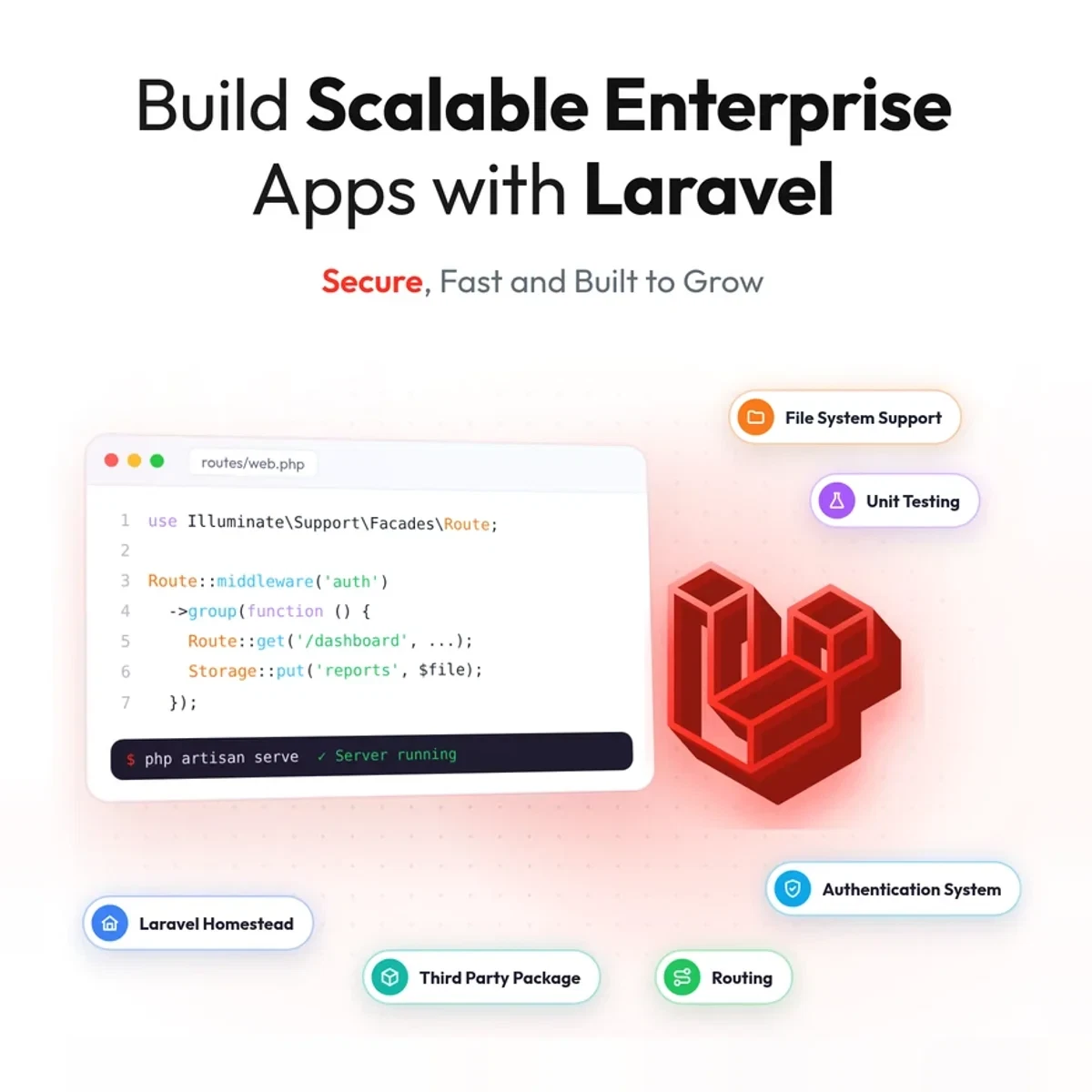
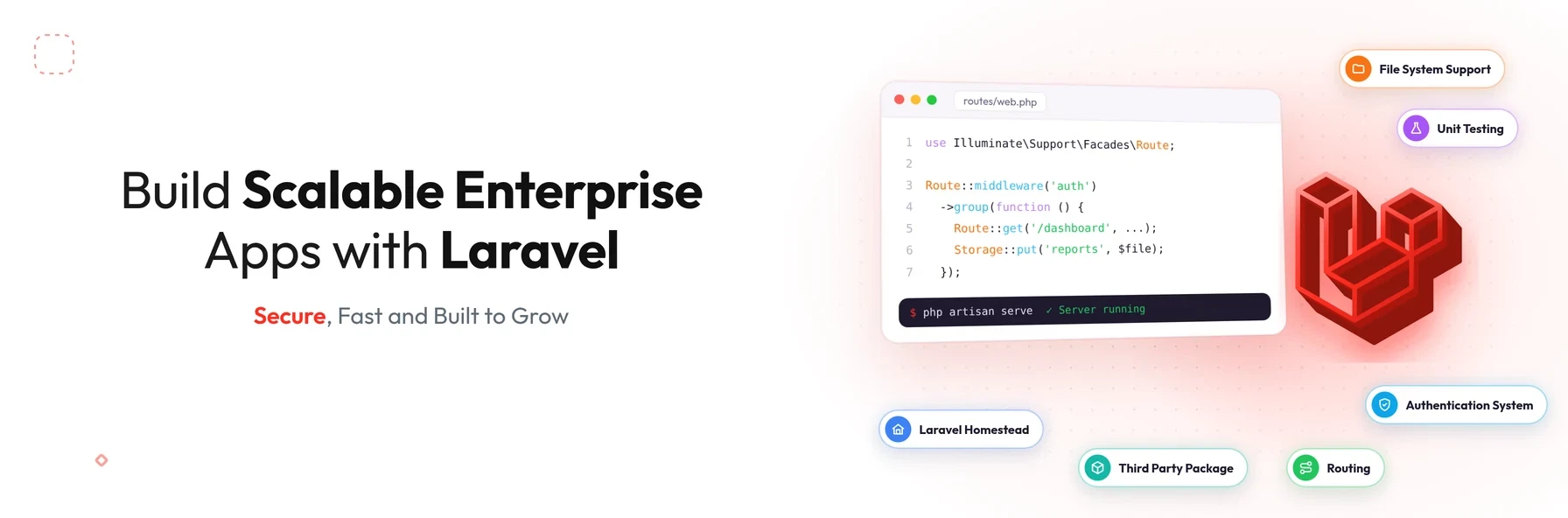
Laravel's routing system clearly defines how each URL and API endpoint is handled. Named routes generate the correct URLs automatically, so links do not break when URLs change. Middleware applies rules such as authentication or logging across groups of routes, and route caching speeds up routing in production.
For APIs, Laravel offers API resources to format responses consistently, along with built-in rate limiting and token authentication.
Enterprise benefit: reliable, well-structured APIs for mobile apps, partner integrations and internal systems.
5. Flexible file storage
Laravel's file storage system, built on the Flysystem library, provides one consistent way to work with local storage, Amazon S3 and other cloud services, and SFTP. Switching storage location is mostly a configuration change rather than a code rewrite.
Enterprise benefit: documents and media can move to scalable cloud storage without rewriting the application.
6. Automated testing built in
Laravel supports PHPUnit and Pest out of the box and includes helpers for testing HTTP requests, databases, queues, events and emails. Laravel Dusk adds browser testing. A good test suite runs automatically to make sure new changes do not break existing features.
Enterprise benefit: fewer bugs reach production, releases are safer, and developers spend more time building features and less time chasing regressions.
7. Consistent development environments
Laravel Homestead, a pre-packaged virtual machine, was once the standard way to set up a consistent local environment. Today, teams more commonly use Laravel Sail, a Docker-based environment, or Laravel Herd for local development.
Enterprise benefit: new developers can start contributing quickly, and "it works on my machine" problems are reduced.
8. Official packages for common enterprise needs
Laravel offers a growing set of official packages that solve common requirements without custom code:
- 01Laravel Cashier: subscription billing with Stripe or Paddle.
- 02Laravel Scout: full-text search.
- 03Laravel Horizon: queue monitoring.
- 04Laravel Telescope: debugging and insight during development.
- 05Laravel Pulse: application performance monitoring.
- 06Laravel Envoy: running common tasks on remote servers, such as deployments.
Enterprise benefit: faster delivery of well-supported features, with less custom code to maintain.
9. Easy integration with existing systems
Enterprises rarely build in isolation. Laravel integrates easily with ERP, CRM, accounting, payment and identity systems through REST APIs, webhooks, queues and a large ecosystem of packages.
Enterprise benefit: your new application can share data automatically with the systems you already rely on. Our Odoo e-commerce integration article shows how system integration removes manual work.
10. Maintainability, community and long-term support
Laravel's clear conventions, MVC structure and excellent documentation make large codebases easier to understand and maintain over time. It follows a regular release schedule, with defined support periods for bug fixes and security fixes. A large global community and talent pool also make it easier to find experienced Laravel developers.
Enterprise benefit: lower long-term maintenance costs and less dependency on any single developer.
Laravel vs Other PHP Frameworks for Enterprise
| Framework | Strengths | Typical fit |
|---|---|---|
| Laravel | Developer productivity, rich official ecosystem, strong documentation and community | Business applications, SaaS platforms, APIs and portals |
| Symfony | Highly modular, reusable components, long-term support releases | Large, complex enterprise systems; Laravel itself uses several Symfony components |
| CodeIgniter | Lightweight, simple and fast to learn | Smaller applications with simpler requirements |
| Laminas (formerly Zend Framework) | Enterprise-oriented, component-based design | Organisations with existing Zend or Laminas systems |
All four can be used for professional applications. For many businesses, Laravel offers the best balance of speed of development, ecosystem and maintainability.
Enterprise Considerations
To get the best from Laravel at enterprise scale:
- 01Plan the architecture. Design for modularity, clear boundaries and scalability from the start.
- 02Invest in performance. Use caching, queues, database optimisation and suitable cloud hosting.
- 03Plan upgrades. Keep within supported Laravel and PHP versions for bug and security fixes.
- 04Set up CI/CD and monitoring. Automate testing and deployment, and monitor performance and errors in production.
- 05Govern packages. Review third-party packages for quality, maintenance and security.
When Is Laravel the Right Choice for an Enterprise Application?
Laravel is a strong fit when you need:
- a business-critical web application, portal or SaaS platform
- secure APIs for mobile apps, partners or internal systems
- integration with ERP, CRM, finance or other enterprise systems
- fast delivery without compromising maintainability
- a modern replacement for an ageing PHP application
For very specialised, low-level or extremely high-throughput services, a different language or a mix of technologies may also be appropriate. For background on how platforms evolve as they grow, read From MVP to Enterprise.
Conclusion
Laravel gives enterprises a rare combination of speed, structure and security. Scalable queues and caching, robust authentication, clean APIs, flexible storage, automated testing and a rich set of official packages let teams build complex applications faster. The resulting systems are also easier to maintain over time.
Whether your business is small or large, Laravel can support scalable, secure applications with excellent user experiences, provided they are designed and built with care.
Planning an enterprise application or modernising a legacy PHP system?
Schedule a free consultation with BSP Technologies, and we will help you design a Laravel solution built for scale and security.
Schedule a Free ConsultationFrequently Asked Questions
Yes. Laravel provides the features enterprises need, including security defaults, authentication and authorisation, queues, caching, API tools, automated testing and official packages for billing, search and monitoring. With good architecture, hosting and development practices, it can power secure, scalable, business-critical applications.
Yes. Laravel can handle high traffic when it is designed and hosted properly. Queues move heavy work into the background, caching reduces database load, and Laravel Octane improves request performance. Applications can scale horizontally across multiple servers. Performance depends far more on architecture and infrastructure than on the framework alone.
Neither is better in every case. Laravel is often faster to develop with, thanks to its conventions and official packages. Symfony is highly modular and popular for very large, complex systems. Laravel actually uses several Symfony components. The right choice depends on your team, your requirements and your existing systems.
Laravel includes strong protection against SQL injection, cross-site request forgery and cross-site scripting, along with secure password hashing, encryption and rate limiting. Enterprise security also depends on secure coding, regular updates, access controls, monitoring and penetration testing, which apply to any framework.
Laravel releases a new major version roughly once a year, and each release receives bug fixes and security fixes for a defined period. Enterprises should plan regular upgrades to stay on supported Laravel and PHP versions. Check the official Laravel release notes for each version's exact support dates.