
The short answer
A white-label development partner beats a freelancer bench when your agency has sold more build work than your permanent team can deliver, and the project runs longer than a few weeks. Freelancers suit short, well-defined tasks. For anything longer, continuity matters more than day rate, and a stable white-label team protects your deadlines and your client relationship.
What the November labour market figures actually say
The Office for National Statistics published its latest labour market overview on 17 November 2026. Three figures matter if you run a small agency:
- 01Vacancies fell by 22,000 to 690,000 in August to October 2026, compared with the previous three months. That is 37,000 fewer than a year earlier.
- 02The biggest quarterly fall was in businesses with 1 to 9 employees, down 22,000 to 73,000 vacancies. Outside the pandemic, the ONS says that is the lowest level for this size band since April to June 2012.
- 03Payrolled employees fell by an estimated 34,000 in October to 30.2 million. The ONS flags this early estimate as provisional and likely to be revised.
All three figures come from the ONS bulletin (ONS, Labour market overview, UK: November 2026).
The ONS also explains why. Feedback from its Vacancy Survey suggests "smaller firms may not be recruiting because of labour costs and other economic conditions". Appcast senior economist Julius Probst, writing a day later, linked much of the slowdown to higher employer National Insurance contributions and minimum wage rises (Onrec).
None of this is agency-specific data. But most UK digital agencies are small firms, and the pattern will feel familiar. You are still winning work. You are not adding permanent developers to deliver it.
Why the freelancer bench breaks mid-project
When hiring stops, most agencies fill the gap the same way: a WhatsApp group of trusted freelancers. It works, until it doesn't.
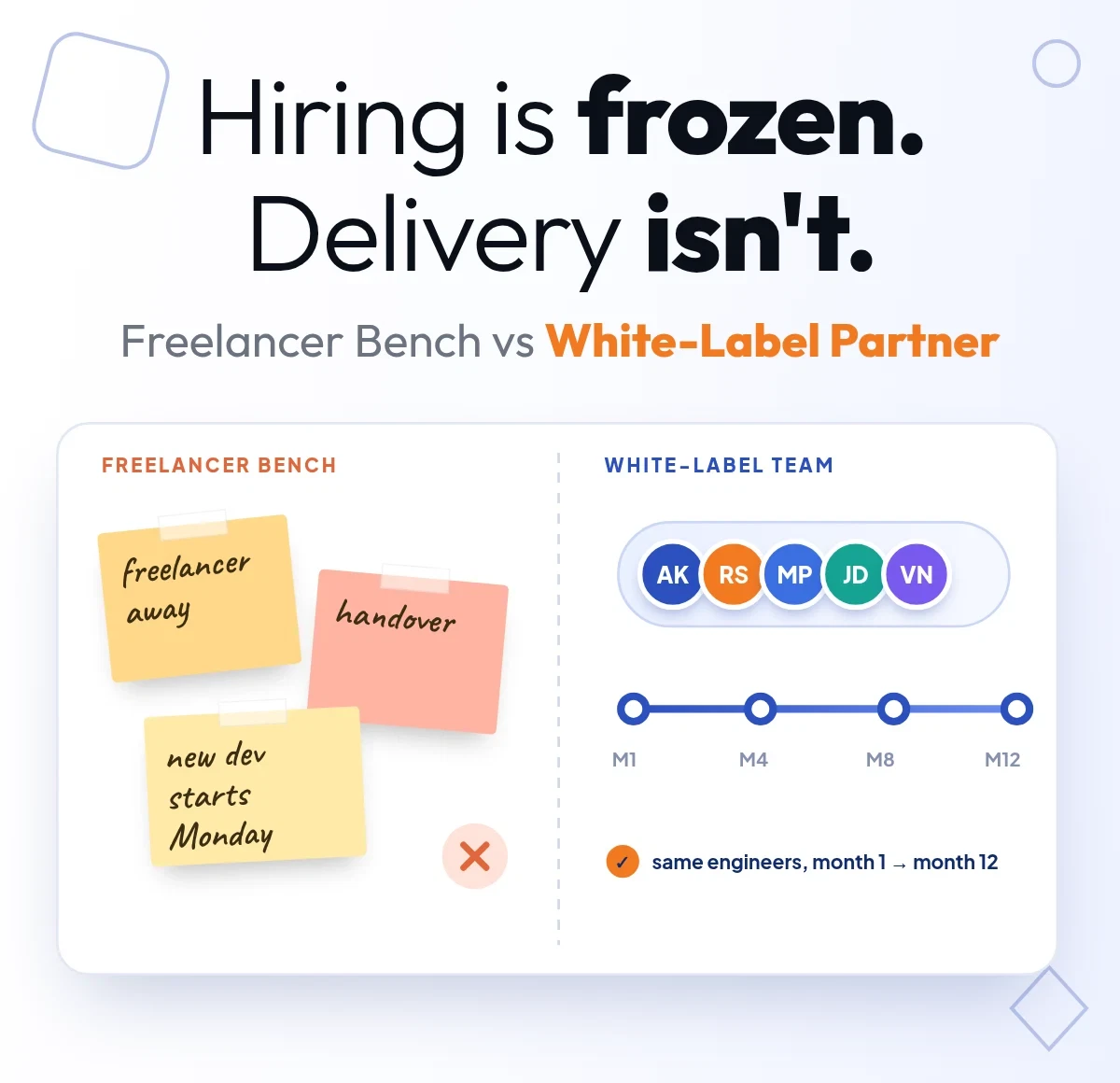
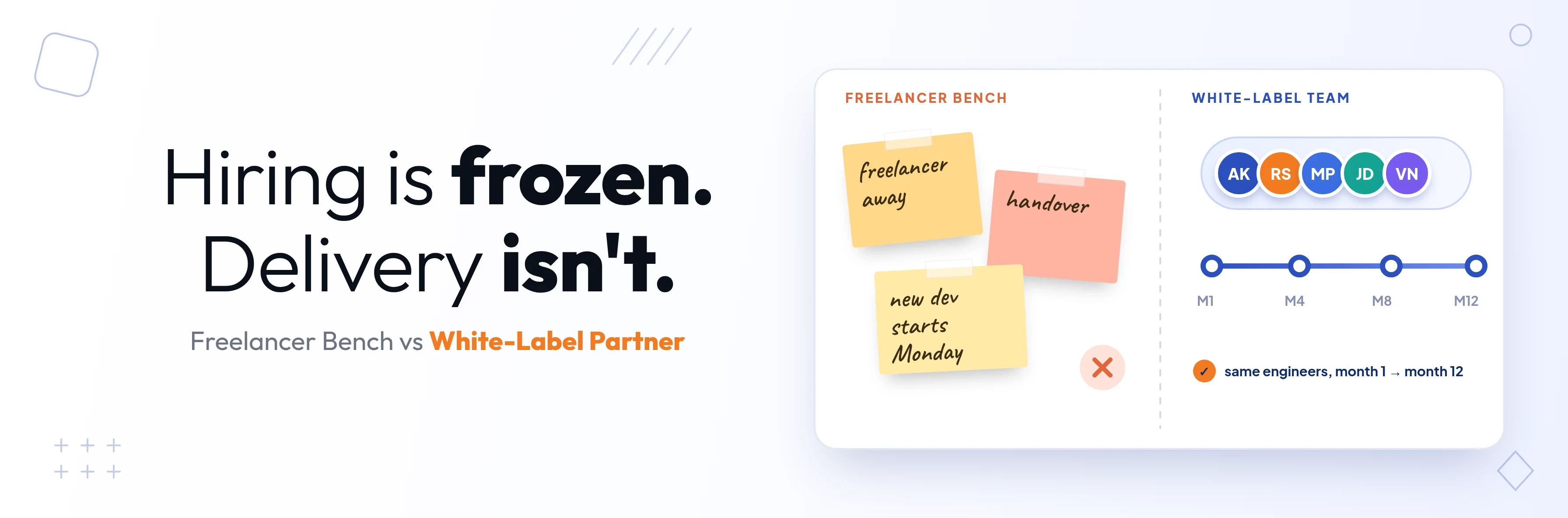
The problem is rarely skill. Good freelancers are often excellent engineers. The problem is availability. A freelancer's best client is whoever pays them next month. If a bigger contract lands, your project slides down their list. If they take a break, nobody else knows the codebase.
That shows up in three ways:
- 01Handover tax. Every time a new developer joins, someone senior on your side spends days re-explaining the project. That time is rarely billable.
- 02Knowledge walks out. Decisions live in one person's head. When they leave, the next developer rewrites what they don't understand.
- 03Your client feels it first. Missed demos, inconsistent code quality and slow bug fixes land on your agency's reputation, not the freelancer's.
None of these show up in a day-rate comparison. All of them show up in your margin.
Freelancer bench vs contractor vs white-label partner
| Freelancer bench | Day-rate contractor | White-label development partner | |
|---|---|---|---|
| Best for | Short, defined tasks | A specific skill gap for a fixed period | Ongoing client delivery over months or years |
| Continuity | Low - depends on each person's diary | Medium - one person, one contract | High - a team with replacement cover |
| Who manages the work | You, person by person | You | A delivery lead on the partner side, reporting to you |
| Client visibility | Often unclear | Usually works under your name | Invisible by design, unless you choose otherwise |
| Knowledge retention | Sits with individuals | Sits with one person | Shared across the team and documented |
| Risk if someone leaves | Project stalls | Project stalls | Partner replaces and hands over internally |
If most of your sold work is short and well specified, a bench of freelancers may be fine. If you are selling platforms, apps or ongoing retainers, the table points one way. For longer product work, a dedicated remote development team is the same idea at a bigger scale.
Six checks before you hand a white-label partner your client
Not every white-label partner solves the continuity problem. Some are a freelancer bench with a logo. These six questions sort them quickly.
1. Ask who is on your project in month six
Get named engineers, not "a team", and ask what share of their engineers stay year on year. If they can't answer with a number, that is your answer. High churn at the partner becomes high churn on your project.
2. Ask what happens when someone leaves
People do leave. Ask how much notice you get, who covers, and whether the handover happens on their time or yours.
3. Ask how they stay invisible
Agree the rules up front: which tools they work in, whose email domain they use, and whether they ever speak to your client directly. Write it into the contract.
4. Ask who owns the code and the access
Code should live in repositories your agency controls, and access should be removed the day someone rolls off. We covered the security side in detail in our supply-chain risk checklist.
5. Ask what happens when scope changes
Your client will change their mind. Agree how change requests are estimated, approved and billed before the first one arrives.
6. Ask who senior reviews the work
Find out who checks architecture and scope at kickoff. If the answer is "the developer", you are buying hours, not judgement.
What this looks like in practice
I'll tell you what you need to hear, not what you want to hear: a white-label partner is not the right answer for every agency. If your work is mostly small website builds, keep your freelancers.
But if you are selling serious build work, here is what continuity looks like at BSP Technologies:
- 0195% team retention, against an industry average of 30-40%. The engineers who start your project are the ones who finish it.
- 02A 10-year partnership with Tyre Channel UK. We took the business from paper to a fully digital platform, with more than £10M of business impact and no missed delivery.
- 0380% of our clients come back for a second engagement, and we're rated 4.9★ on Clutch.
- 04I personally review every project at kickoff, so scope and architecture are set at the right level before any code is written.
Your client never has to know we're involved unless you want them to. You can read more about how that works on our white-label development page.
If you have sold work you are not sure how to staff, the fastest way to see if we fit is a 30-minute call. Book a 30-minute call with Nirav. Prefer to read first? See how our white-label development for agencies service works.
Book a 30-minute call with Nirav
Got sold work you're not sure how to staff? Tell him the project and he'll tell you plainly whether we fit.
Book a 30-minute call with NiravFrequently Asked Questions
A white-label development partner is an external engineering team that builds software under your agency's name. Your client deals with you, the work ships under your brand, and the partner stays invisible unless you choose to introduce them.
Not always on day rate. The saving usually comes from continuity: fewer handovers, less re-briefing, and fewer missed deadlines when a freelancer becomes unavailable mid-project.
Only if you want them to. A good partner works in your tools, under your email domain or project accounts, and never contacts your client directly unless you ask.
It depends on scope and the skills needed. The honest answer comes after a short scoping call, not in a first email. Be wary of anyone who promises a start date before understanding the project.
That should be set in the contract before work starts. For most agency work, ownership passes to the agency or its end client, and the code lives in repositories the agency controls.
Sources
1. Office for National Statistics, Labour market overview, UK: November 2026, 17 November 2026: ONS labour market overview
2. Onrec, UK payroll falls by 34,000 as rising employment costs hit hiring (analysis by Julius Probst, Appcast), 18 November 2026: Onrec article
3. ITV News, Jobless rate eases back unexpectedly as vacancies tumble further, 17 November 2026: ITV News report
BSP figures (95% team retention, 80% repeat clients, 4.9★ Clutch, Tyre Channel UK partnership) are BSP Technologies' own data.