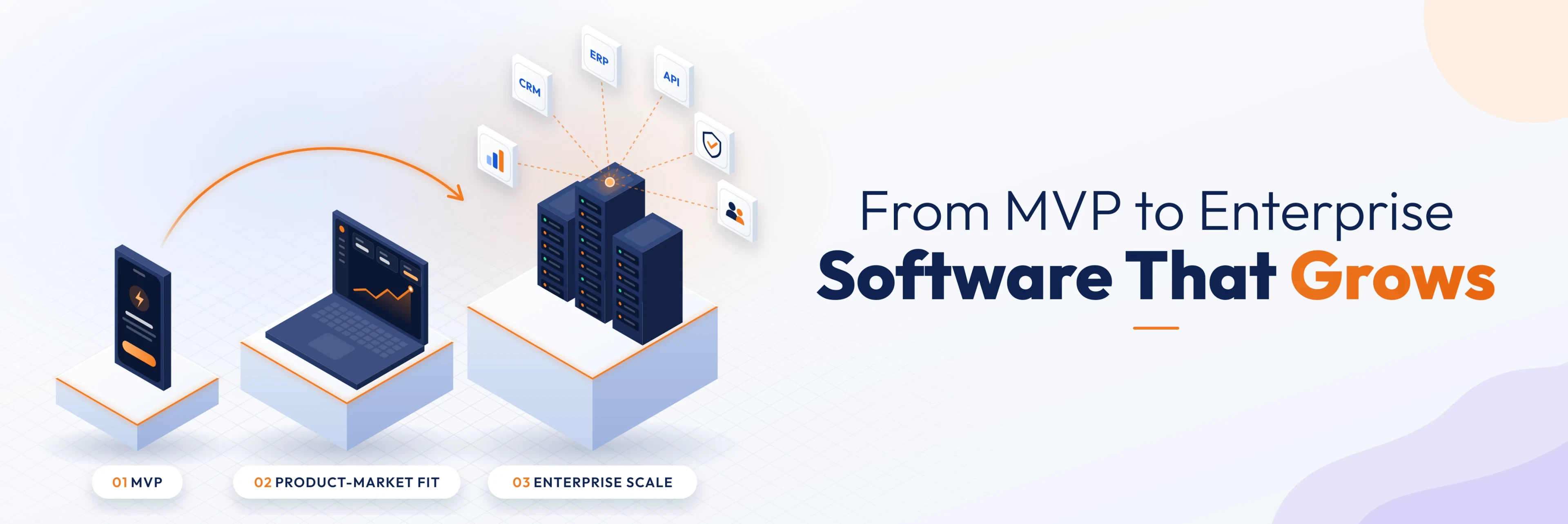
Great software evolves from an MVP to an enterprise platform in stages: validating an idea, reaching product-market fit, then scaling for complexity, with the architecture maturing at every step. An MVP proves an idea works. It rarely represents the software a growing business will rely on three, five or ten years later.
Many businesses treat launching their Minimum Viable Product (MVP) as the finish line. In reality, it's the starting point. As customer expectations rise, operations grow more complex and transaction volumes increase, software has to evolve with the business. The companies that build lasting digital products treat software as a long-term business asset with a roadmap aligned to growth, not a one-off project.
Key takeaways
- An MVP is built to validate an idea quickly, not to run a business indefinitely.
- Priorities shift at each stage, from learning, to reliability, to scale and control.
- Early architecture decisions decide whether growth means steady improvement or an expensive rebuild.
- Great software is never finished; continuous improvement is what turns it into a competitive advantage.
Why Isn't an MVP Enough for a Growing Business?
An MVP lets a business test whether a product solves a real problem before investing heavily. It focuses on the core value proposition, gathers user feedback and reduces market risk. What it isn't designed to do is support a much larger operation.
As a business grows, the cracks tend to appear in predictable places:
- 01Performance: features that worked for the first hundred users struggle with ten thousand.
- 02Operations: manual workflows that suited a small team become bottlenecks.
- 03Integrations: connections that seemed unnecessary at launch become essential.
- 04Maintainability: a lean codebase becomes hard to change if it was never designed to evolve.
Businesses that don't plan for this evolution often face expensive rebuilds, mounting technical debt and missed growth opportunities. The goal isn't to build an enterprise system on day one; it's to build an MVP that can grow into one.
The Three Stages of Software Evolution at a Glance
| Stage | Main goal | What success looks like | Typical priorities |
|---|---|---|---|
| 1. MVP | Validate the idea | Real learning about customer demand | Core feature, speed, feedback |
| 2. Product-market fit | Deliver a reliable product to a growing base | Retention and steady growth | Onboarding, reporting, performance, security |
| 3. Enterprise scale | Support complexity and larger customers | Stability at volume, enterprise sales | Access control, integrations, audit trails, automation |
Stage One: Turning an Idea Into a Working Product
The first stage is about proving the idea has potential. Success is measured by what you learn, not by how many features you ship. The focus should be on understanding customer behaviour, validating demand and collecting feedback that shapes what comes next.
An effective MVP does one thing exceptionally well. Every extra feature adds complexity, extends timelines and introduces risk. At this stage, good practice looks like:
- Solving one primary problem, not several
- Keeping user journeys simple
- Releasing quickly and iterating on real feedback
- Testing assumptions about what customers actually need
Technology choices still matter, though. Choosing scalable frameworks, keeping code clean and setting a sound architectural foundation can dramatically reduce redevelopment costs later. The balance is to avoid over-engineering the MVP without making short-term decisions that become long-term problems.
Stage Two: Product-Market Fit Changes Everything
Once an MVP gains traction, priorities shift from validating an idea to delivering a reliable experience for a growing customer base. This is often when businesses discover that development doesn't slow down after launch; it becomes more strategic.
Customer feedback now drives the roadmap. Features that seemed vital in planning may prove unnecessary, while real-world use reveals new requirements. Common priorities at this stage include:
- Smoother user onboarding
- Reporting and analytics
- Stronger security
- Workflow automation
- Faster response times and more stable infrastructure
Businesses that keep refining their product based on market feedback are far more likely to grow sustainably than those that treat software as finished once it's live.
Stage Three: Scaling to an Enterprise Platform
As the customer base grows and larger organisations come on board, the product has to handle more users, more data and more demanding requirements. Enterprise buyers expect control, security and accountability as standard, not as add-ons.
Capabilities that typically become essential at this stage include:
- 01Role-based access so different teams see and do only what they should
- 02Integrations with the CRM, finance, ERP and other systems customers already use
- 03Audit trails that record who changed what, and when
- 04Advanced reporting for managers and decision-makers
- 05Workflow automation to handle volume without adding headcount
The key is to introduce these when they solve genuine business needs, not before. Businesses whose earlier architecture was built to evolve can add enterprise features steadily; those that cut corners often find themselves facing a rebuild just as growth accelerates.
Great Software Is Never Finished
The most successful software products aren't the ones that launch with the most features. They're the ones that keep improving as the business evolves. Every new customer, market, operational change and technology shift is an opportunity to refine the product and deliver more value.
This mindset separates businesses that scale from those that end up stuck with outdated systems. Rather than waiting for software to become a problem, they invest continuously in:
- Stronger architecture and performance
- Better integrations across their technology estate
- AI-powered workflows where they add real value
- Support for higher transaction volumes and connected devices
- Modernising legacy components before they hold the business back
Over time, these incremental improvements compound into a platform that is a genuine competitive advantage rather than just another business tool, and one that can adapt to changing markets without disrupting operations.
Why Does Choosing the Right Technology Partner Matter?
The journey from MVP to enterprise is rarely predictable. Priorities change, customer expectations evolve and new technologies create opportunities that didn't exist at launch. Navigating that takes more than development capacity; it takes a partner who understands how products evolve.
A good engineering partner looks beyond the next feature. They consider:
- 01Architecture that can scale without a rebuild
- 02Maintainability so the product stays easy to change
- 03Integrations that fit the wider business
- 04Security appropriate to the product's stage and customers
- 05Long-term product health, keeping technical debt under control
At BSP Technologies®, this long-term mindset shapes how we build and support products. From developing MVPs for ambitious start-ups to modernising enterprise platforms, integrating AI, connecting hardware devices and scaling SaaS applications, our focus is helping businesses grow through technology that evolves with them. Our long-standing client relationships and ongoing product engineering engagements reflect a simple belief: successful software is built through continuous partnership, not one-off delivery.
Conclusion
An MVP is an important milestone, but it should never be the final destination. As a business grows, its software must keep pace with rising customer expectations, operational complexity and new market opportunities. The products that stand the test of time evolve through thoughtful engineering, strategic planning and continuous improvement.
Building software that grows with your business isn't about predicting every future requirement. It's about creating the right technical foundation, making scalable decisions and working with an engineering team that understands the bigger picture.
Planning Your Next Stage?
Whether you're planning a new product, scaling an existing platform or modernising software that no longer fits your business, the right engineering decisions today will shape your competitive advantage for years to come. Talk to BSP Technologies® to build a roadmap that takes your software from where it is now to where your business needs it to be.
Talk to Our TeamFrequently Asked Questions
An MVP is a focused first version built to validate an idea quickly with real users. Enterprise software is built to support large user bases, complex operations and demanding customers, with capabilities such as role-based access, integrations, audit trails, advanced reporting and strong security.
There's no fixed timeline. Some businesses begin scaling within months; others take several years. It depends on customer adoption, funding, market demand and how quickly the product roadmap evolves.
Not necessarily. If the original architecture is scalable and well maintained, software can usually evolve through continuous improvement. A full rebuild is generally only needed when technical debt or outdated technology seriously limits growth.
Maintaining performance and stability while introducing new features. As users and operations grow, architecture, infrastructure, security and integrations all become increasingly important.
When they solve genuine business needs. Role-based access, workflow automation, advanced reporting, integrations and audit trails become valuable as teams, customers and operational complexity grow.
Traditional software development usually delivers a predefined project. Product engineering takes a long-term view, continuously improving the software based on business goals, customer feedback, new technology and future scalability, so the product keeps delivering value long after launch.