
The short answer
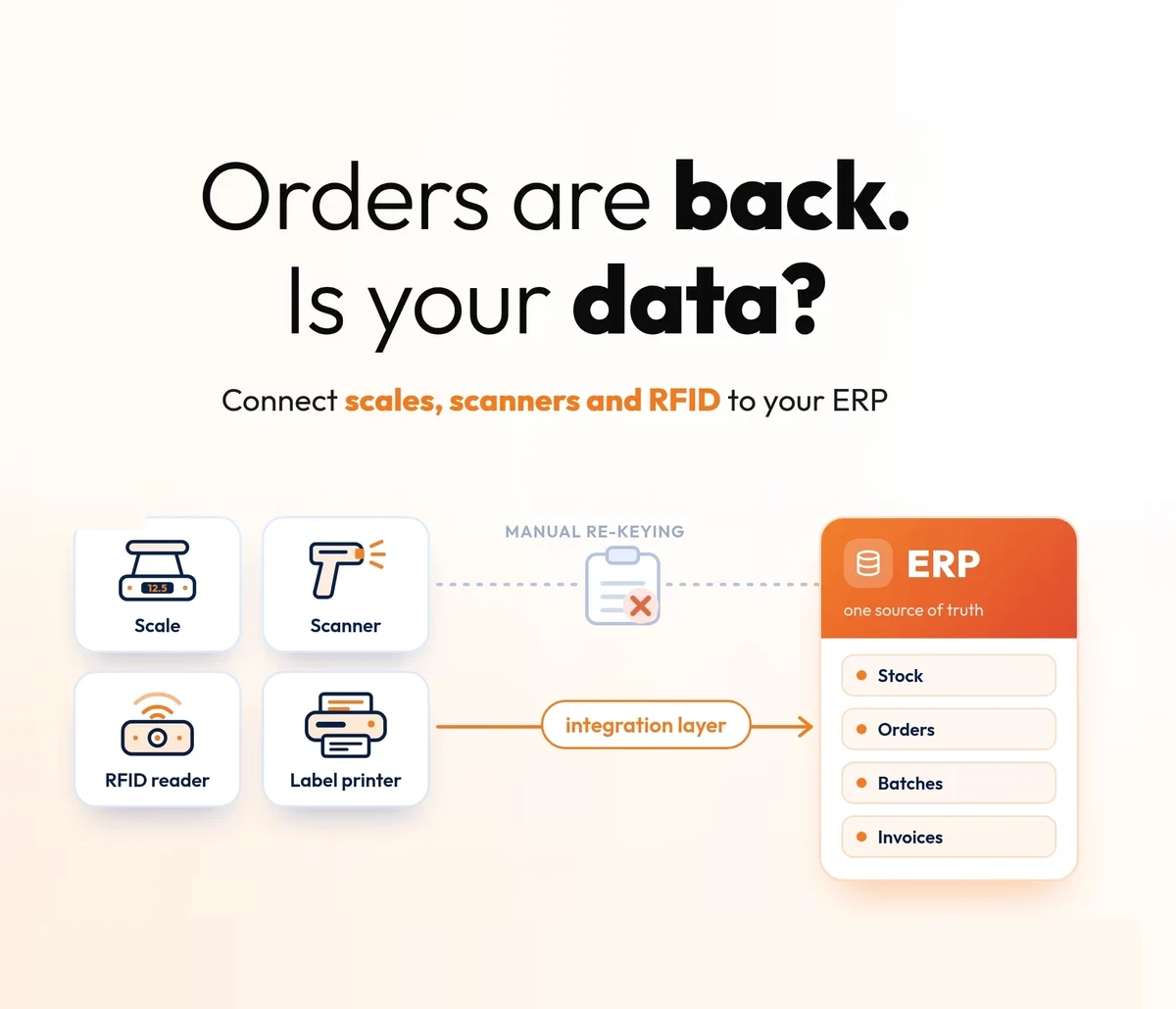
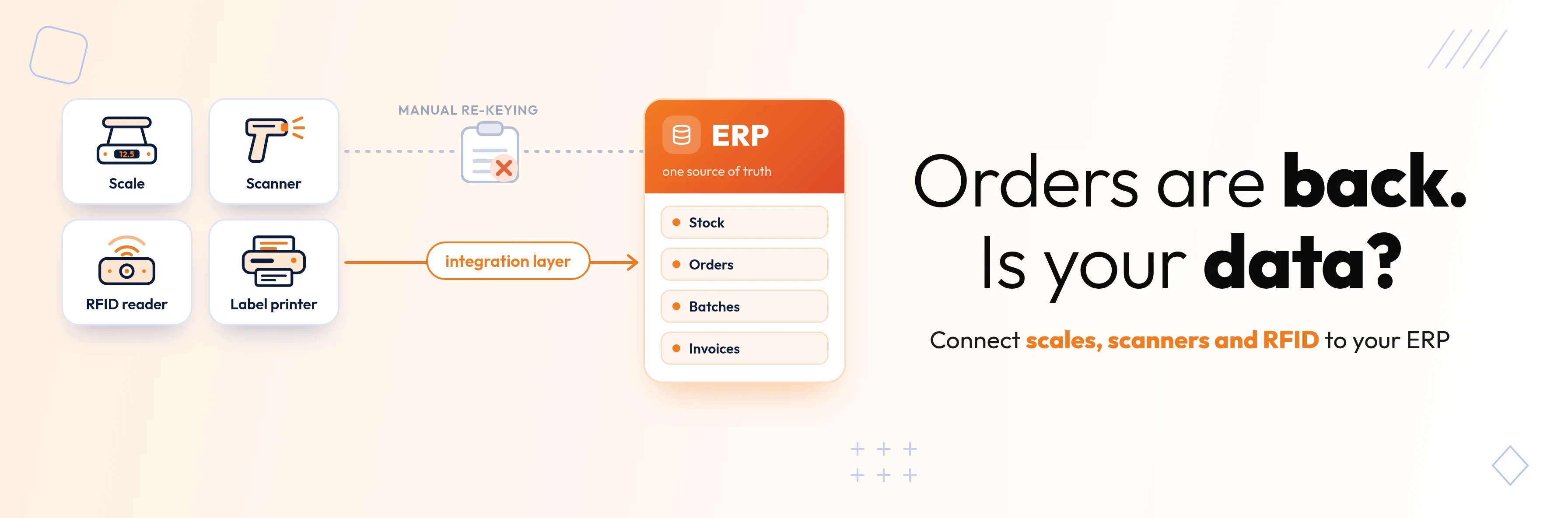
If your weighing scales, barcode scanners or RFID readers don't send data straight into your ERP, someone is typing it in by hand. That works when volumes are low. When orders pick up, re-keying becomes the bottleneck and the main source of errors. You can usually connect existing devices to your current ERP through an integration layer, without replacing either.
What the November CBI survey shows
The CBI's Industrial Trends Survey for November 2026, published on 19 November and based on responses from 251 manufacturers, had the first good news for the sector in a while (CBI via MTA):
- 01Output rose for the first time since May 2024. The output balance moved from -10% in October to +9% in November, with output up in 9 of 17 sub-sectors.
- 02Order books recovered sharply. The total order book balance improved from -32% to -12%, slightly better than the long-run average of -14%.
- 03Firms expect output to stay broadly flat over the three months to February 2027, and selling-price expectations remain well above average.
So demand is coming back, but nobody is forecasting a boom. That combination matters. It means most manufacturers will try to handle more orders with the same people, not hire their way through it.
Earlier this year, a Rockwell Automation survey of OEMs, reported by The Manufacturer, found that 35% of UK respondents named quality control problems and fragile software or IT systems as their biggest barriers to efficiency. Only 3% reported no unexpected downtime at all.
Where the hardware gap hurts when volume comes back
Most mid-sized UK manufacturers already have the hardware. Scales on the goods-in bay. Handheld scanners in the warehouse. Label printers at dispatch. Sometimes RFID on returnable assets.
The problem is what happens between the device and the ERP. In many plants, that link is a person:
- A weight is read off a display and written on a sheet.
- A batch label is scanned into a spreadsheet, then uploaded at the end of the shift.
- A stock count is done on paper and keyed in the next morning.
At low volume, a careful person can keep up. At higher volume, three things happen. Data arrives late, so the ERP shows yesterday's stock. Errors creep in, so invoices, stock and production plans disagree. And your most experienced people spend their time typing instead of running the floor.
Five signs your devices and your ERP aren't talking
- 01Someone re-types numbers from a device display into the ERP or a spreadsheet.
- 02Stock in the ERP is "right as of last night", not right now.
- 03Month-end reconciliation finds the same kinds of errors every time: wrong weights, missed scans, duplicate entries.
- 04Your scanners work, but only with one app that doesn't feed the ERP.
- 05A failed audit or customer complaint was traced back to a manual entry.
If two or more of these sound familiar, the issue is integration, not hardware.
Integrate, replace, or wait?
| Option | When it makes sense | Main risk |
|---|---|---|
| Integrate existing devices with your current ERP | The ERP still runs the business well and has an API, import routine or database access | Needs a well-designed integration layer, or it becomes another fragile link |
| Replace the ERP | The ERP is unsupported, can't scale, or blocks basic processes | Long, expensive, and disruptive; hardware still needs integrating afterwards |
| Wait | Volumes are genuinely low and errors are rare | Manual work grows as orders recover, and so do mistakes |
In my experience, integration is usually the right first move. If the ERP itself is the real problem, that's a different conversation about phased legacy modernisation, not a big-bang replacement.
How to connect shop-floor hardware to your ERP in six steps
1. List every device and every re-keyed number
Walk the floor. Note each scale, scanner, RFID reader and printer, how it connects (USB serial, RS-232, Bluetooth, network), and every value someone types into the ERP by hand.
2. Pick the one flow that costs most
Choose the manual flow with the most errors or hours lost. Goods-in weights and dispatch scans are common starting points.
3. Put an integration layer between devices and the ERP
Don't wire devices straight into the ERP. Use a small app or middleware that reads the device, adds context (order, batch, operator) and sends clean data to the ERP. That way you can change a device or upgrade the ERP without rebuilding everything.
4. Design for the network going down
Factory Wi-Fi drops. Good integrations store readings locally and sync when the connection returns, so no scan or weight is lost.
5. Run old and new side by side
For a short period, keep the manual process running and reconcile the two. Switch over only when the numbers match.
6. Extend, one flow at a time
Once the first flow is stable, add the next. Each phase is small, measurable and low-risk.
Can Made Smarter help pay for it?
Possibly. The Made Smarter Adoption programme supports small and medium-sized manufacturers in England to adopt industrial digital technologies, and the government updated its evaluation of the programme on 18 November 2026 (GOV.UK). Support and funding differ by region and change over time, so speak to your regional Made Smarter programme before you plan around a grant.
What this looks like in practice
I'll tell you what you need to hear: not every plant needs a big integration project. Sometimes one well-built connection between a scale and the ERP removes most of the pain.
Here's the kind of work BSP Technologies does in this space:
- 01A hardware-connected field operations app that talks to Android smart glasses for hands-free barcode scanning, Bluetooth weighing scales for real-time weight capture, and BLE beacons for zone-based tasks, with offline sync back to the backend.
- 02A 15-year-old manufacturing system modernised with zero downtime, phase by phase, while the business kept running.
- 03The app, the device integration and the backend built by one team, so there's one point of contact when something needs to change.
- 04I personally review every project at kickoff, so we agree the first flow and the architecture before anyone writes code.
You can see more on our hardware and software integration page.
If orders are picking up and your team is still the cable between the device and the ERP, the quickest way to find out what's fixable is a 30-minute call. Book a 30-minute call with Nirav. Prefer to read first? See how our hardware and software integration service works.
Book a 30-minute call with Nirav
Still the cable between the device and the ERP? Tell him the flow that hurts most and he'll tell you plainly what's fixable.
Book a 30-minute call with NiravFrequently Asked Questions
Usually, yes. Most industrial scales output data over USB serial, RS-232 or Bluetooth. An integration layer reads that data, adds context such as the order or batch, and sends it to the ERP, so nobody has to type the weight in.
Not usually. If the ERP has an API, import routine or database access, devices can be connected through an integration layer. Replacement only makes sense when the ERP itself can no longer support the business.
A well-built integration stores readings locally on the device or app and syncs them when the connection returns, so no scans or weights are lost.
Made Smarter Adoption supports SME manufacturers in England to adopt industrial digital technologies. Eligibility and funding vary by region and change over time, so check with your regional Made Smarter programme before you plan around it.
It depends on the devices, the ERP and how many flows you connect. Starting with one high-cost flow keeps the first phase small and gives you a firm answer quickly.
Sources
1. CBI, Industrial Trends Survey - November 2026, published 19 November 2026, reposted by the Manufacturing Technologies Association on 20 November 2026: CBI via MTA
2. GOV.UK (Department for Business and Trade), Made Smarter Adoption: impact and process evaluation, first published 30 July 2026, updated 18 November 2026: GOV.UK evaluation
3. The Manufacturer, Quality systems top UK manufacturers' priorities amid rising cyber risk (Rockwell Automation OEM survey), 27 February 2026: The Manufacturer article
4. Made Smarter: madesmarter.uk
BSP project details (hardware-connected field operations app, 15-year-old system modernised with zero downtime) are BSP Technologies' own work.