
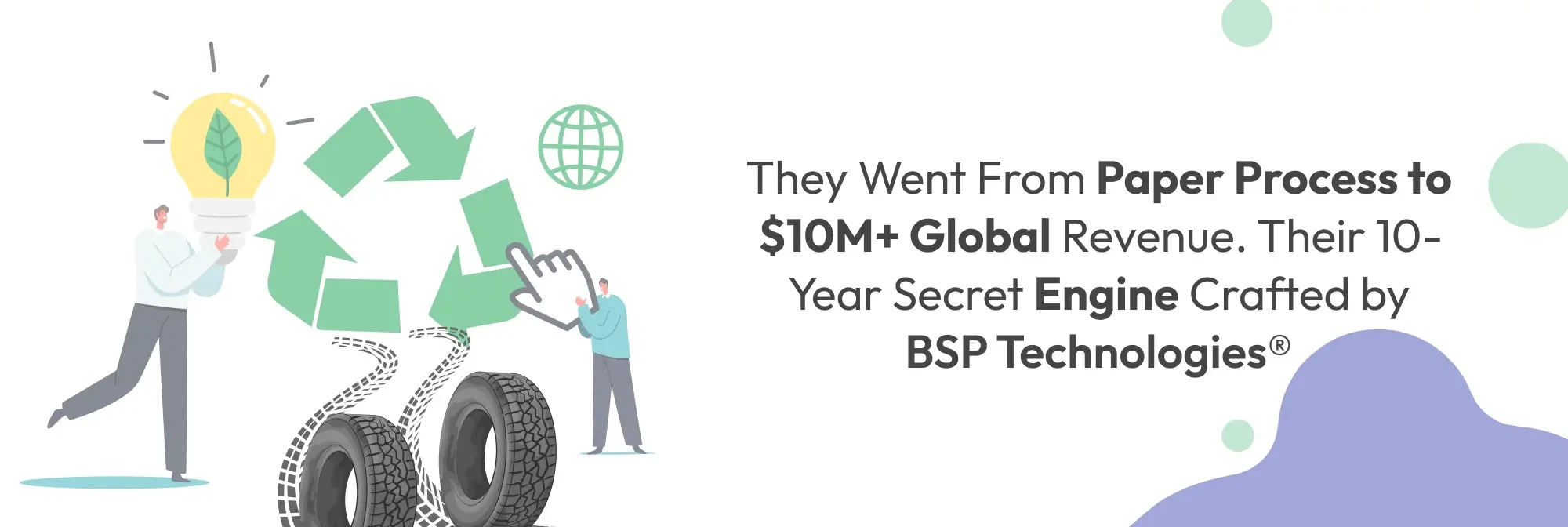
In short: In 2013, a UK tyre collection business ran on paper bookings, manual invoicing and slow compliance reporting. From 2014, BSP Technologies built a single core platform covering scheduling, trip planning, driver verification, invoicing and payments. Configured for each country's rules, that same platform has since supported the business's growth from one UK site into several countries.
In 2013, a tyre collection business in the United Kingdom started with a single site and a small operational team. Its processes depended entirely on manual effort. Drivers took bookings on paper. Compliance reporting was slow. Invoices, statements and customer records were created and checked by hand.
The work was honest and demand was high, but the process was not built for scale.
In 2014, the company partnered with BSP Technologies® to answer one question:
How do we build a system today that will not break when the business is ten times larger tomorrow?
Over the following decade, the answer shaped an entire digital platform. This case study explains how the platform started, how it scaled across countries, and what other growing waste businesses can learn from it.
The First Transformation: From Manual Chaos to Predictable Operations
The starting point was simple. Customers were requesting collections, but handling those bookings on paper or through ad-hoc calls created delays, errors and bottlenecks.
To fix this, BSP Technologies designed an appointment-based collection model:
- 01 Customer requests a tyre collection
- 02 Operations team plans grouped trips by quantity, location and availability
- 03 Driver receives an assigned route
- 04 Driver records each collection
- 05 Quality check confirms the quantity matches the customer's declaration
- 06 Invoice issued and payment tracked (online, BACS or cash)
Each stage now had a clear record. Customers could request collections in a structured way, and the operations team could plan trips instead of reacting to calls. Drivers worked from assigned routes. Quality checks confirmed that what was collected matched what the customer had declared. Invoices and payments became trackable, whether customers paid online, by BACS transfer or in cash.
For the first time, the business had visibility, traceability and control over every collection. This shift laid the foundation for everything that followed.
Scaling From One Site to Multiple Countries
Expansion moved quickly, from the UK to Switzerland, Romania, Africa and India. Each new region brought its own compliance requirements, workflows and reporting formats.
Rather than building a separate system for every market, the group relied on a single core engine built by BSP Technologies and configured for each country's rules. This gave the business a growing international footprint while keeping control consistent across regions. Because the core stayed the same, entering a new market meant configuring local rules rather than rebuilding the way the business works.
Compliance requirements differ from country to country. In the UK, for example, the waste duty of care requires businesses to describe waste accurately, pass it only to authorised persons and keep transfer records, as set out in the government's waste duty of care code of practice. Cross-border movements of waste are subject to additional waste shipment controls. A platform can be configured to support these processes, but each business remains responsible for meeting the rules in every country where it operates.
What the Platform Makes Possible Today
Across countries, the platform supports:
- tyre collection scheduling
- trip planning designed to maximise loads and reduce cost
- driver accountability through verified collections
- automatic invoice generation with country-specific rules
- customer-specific pricing layered on top of business-level pricing
- combined statements for franchise-style groups
- online payment and BACS tracking
- mobile access for customers to submit compliance certificates
Most importantly, leadership can see how much revenue each trip, driver and location generates. That level of transparency is what helps a recycling business operate as a scalable enterprise.
Before and After: How the Operation Changed
| Area | 2013: Manual process | Today: One connected platform |
|---|---|---|
| Bookings | Taken on paper or through ad-hoc calls | Structured, appointment-based collection requests |
| Collections | Delays, errors and bottlenecks | Grouped trips with assigned driver routes |
| Verification | Records checked by hand | Quantities checked against customer declarations |
| Invoicing | Created and checked manually | Generated automatically with country-specific rules |
| Compliance | Slow manual reporting | Country-specific configuration and digital certificate submission |
| Visibility | Limited | Revenue visible by trip, driver and location |
| Footprint | A single UK site | Multiple countries and subsidiaries |
Where the Business Is Today
More than a decade on, the tyre collection business powered by this platform manages:
- thousands of collections
- multiple subsidiaries
- cross-border exports
- region-specific compliance requirements
This is what long-term digital planning looks like. It is not a quick application or a temporary system. It is a living platform that grows with the organisation, year after year.
Lessons for Growing Waste Businesses
The principles behind this project apply to any waste business with plans to grow:
- 01Design for the size you plan to be. A system built only for today's volume often has to be replaced just as growth accelerates.
- 02Standardise the core and configure the local. One shared engine with country-specific rules keeps operations consistent without ignoring local requirements.
- 03Make every collection traceable. Assigned routes, driver records and quantity checks create data the business can trust.
- 04Connect operations to revenue. When you can see what each trip, driver and location earns, decisions about pricing, routes and expansion become clearer.
For a closer look at how consultation shapes a system like this, read our case study on how a consultation-led system improved cost visibility, control and compliance.
Conclusion
When a business scales across countries, the biggest challenge is rarely demand. It is structure.
This project shows that when the right structure is built early, a manual, single-site operation can grow into a multi-country business with predictable, well-controlled operations. The platform did not just digitise paperwork. It gave the business one consistent way of working that could travel with it into every new market.
Planning for the next decade, not just the next six months?
Book a free consultation with BSP Technologies to discuss how a scalable platform could support your growth.
Book a Free ConsultationFrequently Asked Questions
Tyre recycling software helps businesses manage the collection, verification, invoicing and documentation of waste tyres. Depending on how it is built, it can bring booking and scheduling, trip planning, driver records, pricing, payments and compliance documents together in one system.
Yes, if it is designed for it. A common approach is a single core platform with country-specific configuration for compliance rules, invoicing and reporting formats. This keeps processes consistent across regions while reflecting local requirements, which each business must still confirm with local regulators.
Grouping collections by quantity, location and availability helps a business plan fuller loads and avoid wasted journeys. Combined with driver records and quantity checks, it also gives managers clearer data on the cost and revenue of each trip.
Often earlier than expected. Manual processes may work at one site but become harder to control as volumes, staff and locations grow. Building on a scalable foundation early can avoid costly rebuilds later, although the right timing depends on each business's plans and budget.
No. Software can support compliance by organising records, certificates and reporting for each country, but it cannot guarantee compliance on its own. Each business remains responsible for meeting the waste regulations of every country where it operates.