
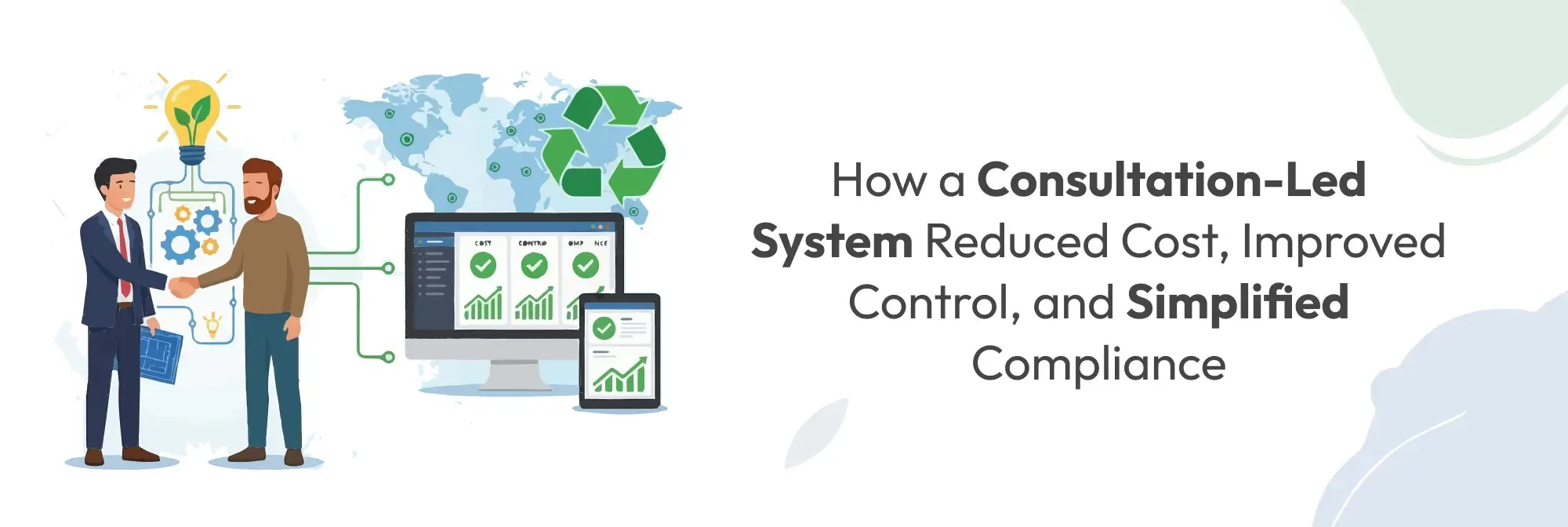
Growing a regulated operations business is not just about handling more volume. It is about keeping control, clarity, and compliance as the business grows.
As this tyre collection company expanded beyond one location, new challenges appeared. Teams increased. Regions changed. Compliance became stricter. What worked earlier no longer worked at scale.
At this stage, using a ready-made software solution would not have solved the real problems. What was needed was a system designed around the business, shaped through careful consultation.
1. When growth exposes gaps
As operations expanded, a few patterns became clear:
- responsibilities were assumed, not clearly defined
- costs were hard to track in real time
- compliance relied too much on manual reporting
- audits created stress instead of confidence
The issue was not effort.
The issue was lack of structure.
The first step was not automation.
It was understanding how the business actually worked.
2. Seeing costs before reducing them
Before reducing cost, leadership needed visibility.
Not just salaries or fuel, but hidden costs such as:
- repeated manual checks
- delayed invoices
- duplicated work
- extra follow-ups
- time lost during compliance reviews
By walking through each operational step with the client, these gaps became visible. Only then could costs be reduced in a meaningful way, without affecting service or compliance.
3. Clear responsibility at every step
One major risk in regulated operations is unclear ownership.
The system was designed so every step had a clear owner. No guessing. No assumptions.
This removed confusion between teams and reduced dependency on individual experience or memory. When something needed attention, it was immediately clear who was responsible.
This alone improved day-to-day operations more than any automation.
4. Compliance as a continuous responsibility
In the UK and Europe, tyre collection comes with long-term responsibility.
Once a tyre is collected, the business remains accountable for:
- who produced the waste
- who sold or transferred it
- who collected it
- how it was processed
- where it was recycled or exported
Each role must be clearly recorded.
Each step must be traceable.
The system was designed to:
- keep waste generators, sellers, and pickup entities clearly separate
- maintain a full audit trail
- produce records whenever required
Compliance was no longer something handled later.
It became part of daily operations.