
Waste management businesses have invested heavily in technology over the past decade. From fleet management and weighbridge systems to customer portals and compliance software, digital tools now support almost every stage of the operation. Yet for many organisations, one problem continues to slow everything down: manual data entry.
The issue isn't that businesses lack software. It's that many systems operate in isolation. Information captured by drivers, weighbridges, finance teams, and customer service departments often needs to be entered, checked, or transferred multiple times before a job is complete. As collection volumes grow and operations become more complex, these disconnected processes create unnecessary administration, increase the risk of errors, and make it harder to see what's happening across the business in real time.
Modern waste management software should do more than digitise paperwork. It should connect systems, automate repetitive tasks, and allow information to flow seamlessly across the business. In this article, we'll explore why manual work still exists, where it typically occurs, and what businesses should look for when choosing software that supports long-term operational efficiency.
The Hidden Cost of Manual Processes
Manual work rarely appears as a single operational issue. Instead, it hides in dozens of small tasks carried out throughout the day. A few minutes spent updating customer records, re-entering weighbridge information, or checking collection details may not seem significant on their own. However, when these tasks are repeated across hundreds of collections every week, they consume a substantial amount of time that could be better spent elsewhere.
Consider a typical waste collection. A driver records the collection, the weighbridge captures the load, the office verifies the information, finance prepares the invoice, and compliance teams generate the required documentation. If these systems aren't connected, employees often end up handling the same information multiple times. Every additional touchpoint introduces the possibility of delays, inconsistencies, or simple human error.
The impact extends beyond administration. Managers struggle to access real-time operational data, customer enquiries take longer to resolve, and reporting becomes a manual exercise rather than an automated process. As the business grows, so does the volume of information moving through the organisation, making these inefficiencies increasingly difficult and expensive to manage.
Why Traditional Waste Management Software Falls Short
Most waste management software wasn't designed to create today's challenges. In fact, when many of these systems were introduced, they solved important operational problems by replacing paper records and simplifying individual tasks. Scheduling, invoicing, customer management, and weighbridge operations all became faster and more organised than they had been before.
The challenge is that modern waste management businesses expect much more from their technology. Information now needs to move seamlessly between departments, sites, drivers, customers, and third-party systems. Many legacy applications were built to perform a specific function rather than support an integrated operation, leaving businesses to bridge the gaps through spreadsheets, manual imports, email attachments, or duplicate data entry.
As a result, software that once improved efficiency can gradually become another source of administration. Instead of enabling teams to focus on operations, it requires them to spend valuable time managing the flow of information between disconnected systems.
The problem isn't necessarily the software itself, but the lack of integration between the tools businesses rely on every day.
Where Manual Work Happens Every Day
Manual work doesn't usually happen in one department. It follows the waste throughout the operational lifecycle. As information moves between drivers, site teams, office staff, finance, and compliance, the same data is often handled multiple times. The more disconnected the systems are, the more manual intervention is required to keep operations running smoothly.
- 01Collection completed: the job is finished on site.
- 02Driver records collection details: job information is captured in the field.
- 03Weighbridge captures weight: the load is weighed on arrival.
- 04Office verifies information: staff check the job and weight data.
- 05Invoice generated: finance bills the customer.
- 06Waste Transfer Note created: the required documentation is produced.
- 07Reporting & compliance: data feeds operational and regulatory reports.
Every handoff shown above is a potential point where information can be duplicated, delayed, or entered incorrectly. Modern waste management software isn't just about digitising these individual steps. Its real value lies in connecting them, allowing data to flow automatically from one stage to the next without repeated manual input. As collection volumes increase, this connected approach becomes essential for maintaining efficiency without increasing administrative workload.
What Modern Waste Management Software Should Do Differently
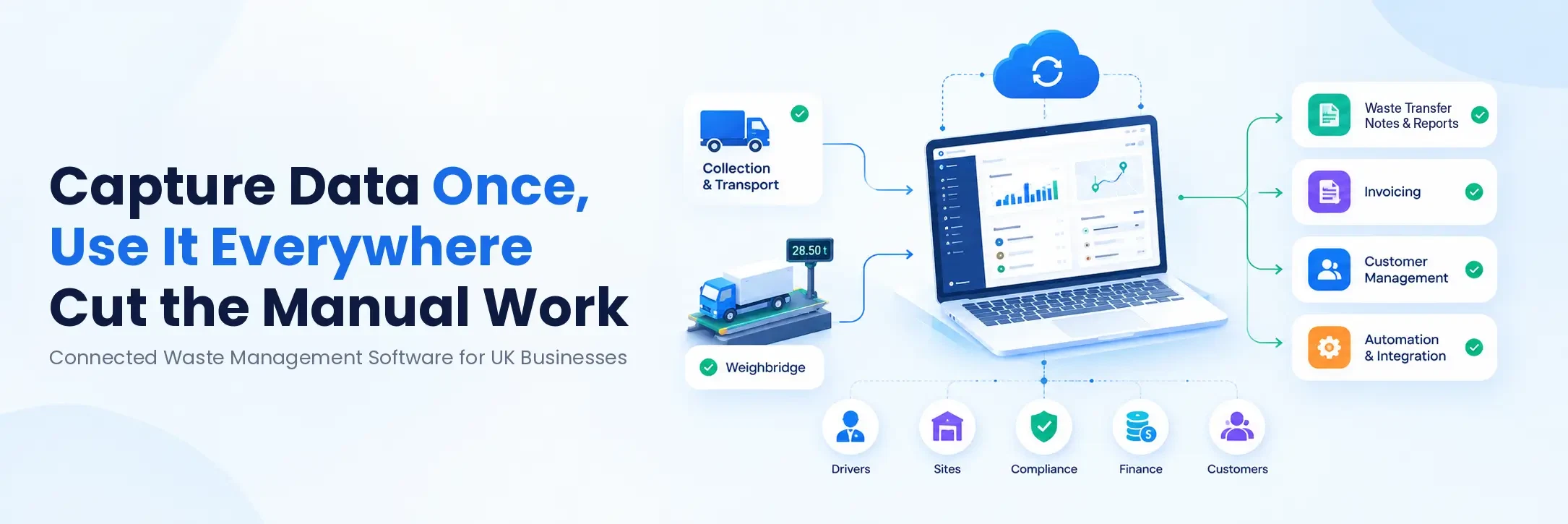
The goal of modern waste management software isn't simply to replace paperwork with digital forms. It should remove unnecessary steps from the entire operation. Instead of asking employees to update multiple systems, it should capture information once and make it available wherever it's needed, whether that's for operations, finance, customer service, or compliance.
This shift is less about adding new features and more about improving how information flows through the business. When systems are connected, routine tasks such as updating customer records, generating invoices, producing Waste Transfer Notes, or creating operational reports happen automatically in the background. Employees spend less time on administration and more time managing collections, responding to customers, and improving operational performance.
For businesses evaluating new software, this means looking beyond feature lists. A platform may include everything from route planning to reporting, but if teams still have to manually move information between systems, the underlying problem remains unsolved.
| Traditional Approach | Modern Approach |
|---|---|
| Data entered multiple times | Data captured once and shared automatically |
| Standalone software | Connected operational ecosystem |
| Manual reporting | Real-time dashboards |
| Reactive problem-solving | Proactive operational visibility |
| Administration increases with growth | Operations scale with minimal manual effort |
Features That Actually Reduce Manual Work
When comparing waste management software, it's easy to focus on long lists of features. However, the features that create the biggest operational impact are often those that eliminate repetitive work behind the scenes.
Mobile applications allow drivers to capture collection details, photographs, signatures, and other job information directly in the field. Weighbridge integrations automatically transfer weight data into operational records without requiring manual updates. Customer portals give clients access to invoices, collection history, and documentation without contacting the office, while automated reporting provides managers with real-time visibility into business performance.
Integration is equally important. Modern platforms should work alongside accounting software, ERP systems, CRM platforms, payment gateways, and compliance tools instead of operating as standalone applications. By allowing information to move automatically between systems, businesses reduce duplicate data entry, improve data accuracy, and create a more efficient workflow across every department.
Building a Connected Operation Instead of Replacing Everything
One of the biggest misconceptions about digital transformation is that businesses need to replace every existing system to improve efficiency. In reality, many waste management companies already have reliable software supporting different parts of their operation. The challenge is bringing those systems together so they function as one connected ecosystem rather than a collection of independent applications.
An integration-first approach allows businesses to protect previous technology investments while removing the manual work created by disconnected processes. Existing weighbridge software, finance platforms, customer databases, mobile applications, and reporting tools can often be connected through APIs and automated workflows, enabling information to move seamlessly without repeated manual input.
This is the approach increasingly adopted by organisations looking to modernise operations without disrupting day-to-day activities. Rather than replacing technology that already works, the focus shifts to creating a unified operational platform where people, processes, and systems remain connected. It's also the philosophy behind how BSP Technologies® develops software solutions for the waste management sector, helping businesses reduce administrative effort while making better use of the systems they already rely on.
Choosing Waste Management Software for Long-Term Growth
Investing in new software is rarely just about solving today's operational challenges. Waste management businesses need systems that can support future growth, adapt to changing regulations, and integrate with new technologies as requirements evolve. Choosing a platform based solely on immediate functionality can result in the same operational bottlenecks resurfacing a few years later.
When evaluating waste management software, decision-makers should look beyond demonstrations and feature lists. Consider how easily the platform integrates with existing business systems, whether it can support multiple sites and growing collection volumes, and how effectively it automates routine processes. Scalability, security, reporting capabilities, and integration flexibility are often far more valuable in the long term than a long list of standalone features.
It's equally important to assess the software provider's approach to development. The waste management industry continues to evolve, with increasing expectations around digital processes, operational visibility, and system interoperability. A platform that is regularly updated and designed to integrate with new technologies is far more likely to deliver lasting value than one that simply meets today's requirements.
Conclusion
Manual work has become so deeply embedded in many waste management operations that it's often accepted as unavoidable. Yet much of this administration isn't created by the complexity of the industry itself. It's created by disconnected systems that force employees to move information manually between departments, applications, and processes.
Modern waste management software should eliminate these inefficiencies rather than digitise them. By connecting operational systems, automating repetitive tasks, and creating a single flow of information across the business, organisations can reduce administrative overhead, improve data accuracy, and give their teams greater visibility into day-to-day operations. The result isn't just faster processes, but a more scalable business that's better prepared for future growth and industry change.
Whether you're replacing legacy software or improving your existing technology landscape, the objective should remain the same: capture information once, use it everywhere, and allow your people to focus on running the business instead of managing data.