
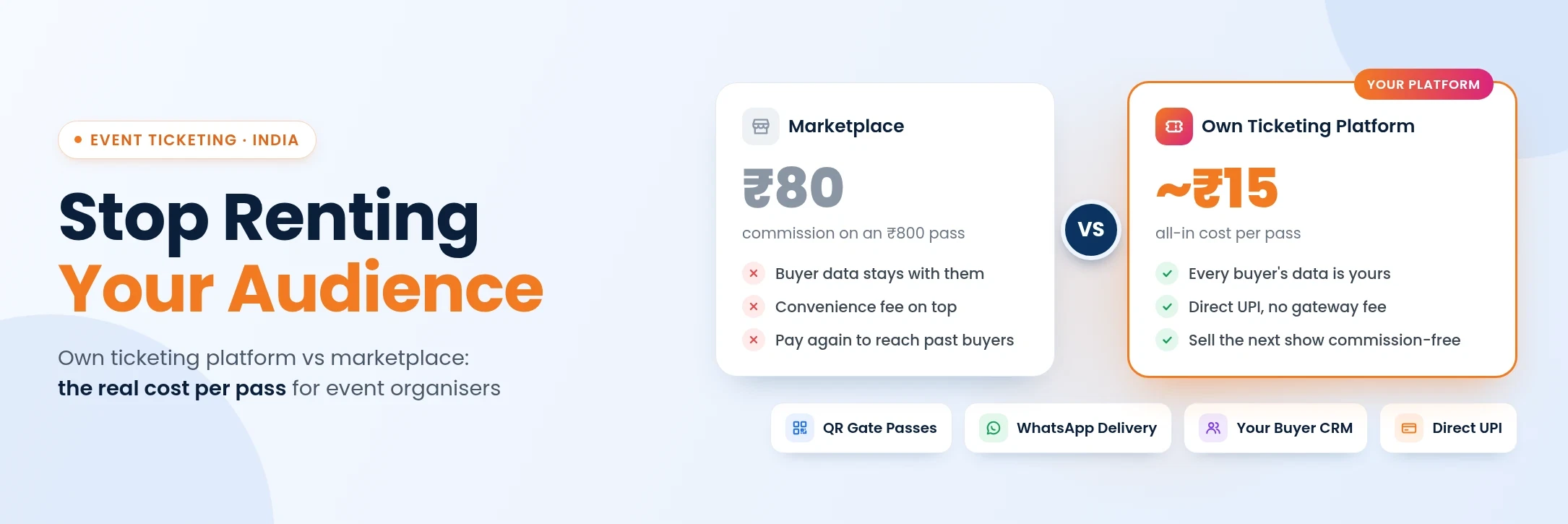
An event organiser's own ticketing platform costs a one-time build fee plus a fixed monthly running cost, while marketplaces like BookMyShow or District take a commission on every pass sold. A small organiser can start with a UPI-based platform for ₹3.5–4.5 lakh that breaks even at around ₹37 lakh in annual ticket sales. More importantly, every buyer becomes your audience for the next show, not the marketplace's.
Marketplaces are excellent at one thing: putting your event in front of people who have never heard of you. But every booking they process also builds their customer database, not yours. When your next show goes on sale, you pay commission again to reach people who have already bought from you.
This guide breaks down the real numbers: marketplace commission, build cost, hosting and WhatsApp cost per pass, and how the maths changes for small and large organisers.
Key takeaways
- Marketplaces typically charge organisers around 10% of ticket value, and the buyer data stays with them.
- Small organisers can start with a Starter platform for ₹3.5–4.5 lakh, using direct UPI with no payment gateway fees.
- Platform and hosting cost about ₹12 per pass at small volumes, with a floor of ₹5 + GST per paid pass and ₹2 + GST per complimentary pass at any scale.
- WhatsApp messaging costs at most ₹1 + GST per message, including marketing and split & share.
- The biggest value isn't saved commission. It's owning your audience.
What Do Marketplaces Actually Charge Organisers?
Most Indian ticketing marketplaces don't publish organiser rates; commission is negotiated per event or per organiser. Here's what is publicly known:
| Platform | Organiser commission | Who owns the buyer data? |
|---|---|---|
| BookMyShow | Around 10% is widely reported, higher on some deals | BookMyShow |
| District (Zomato) | Percentage of gross ticket value, negotiated | District |
| Swiggy Scenes | Not published | Swiggy |
| Other platforms | Not published | Varies |
On top of the organiser's commission, buyers often pay a separate convenience fee, which makes your pass look more expensive than its face value.
The data question became a national talking point in 2025, when comedian Kunal Kamra was delisted by BookMyShow. Reports noted the platform typically takes a 10% cut, and his public request was simply for access to the audience data from his own shows. It's a clear illustration of the risk.
On a marketplace, you rent your audience. You don't own it.
What Does Your Own Ticketing Platform Cost to Run?
Running your own platform involves four types of cost: collecting payments, WhatsApp messaging, managed hosting, and ongoing development and maintenance.
1. Collecting payments
- 01Starter platform: No payment gateway. Buyers pay by UPI directly to the organiser's account, or offline. The organiser confirms the payment in the admin panel, and the pass is issued on WhatsApp. No gateway fee.
- 02Growth and Scale platforms: Automated online checkout through a gateway such as Razorpay, at a standard 2% plus 18% GST, an effective 2.36% per transaction. High-volume organisers can usually negotiate lower rates.
Note: from 15 October 2026, a regulated UPI charge of 0.4% applies to merchant payments above ₹2,000, which affects premium passes.
2. WhatsApp messaging
Budget a maximum of ₹1 + GST (₹1.18) per message. This covers every type: pass delivery, gate reminders, marketing campaigns and split & share, where one buyer splits the bill or forwards passes to friends.
A typical pass needs 2–3 messages (pass, reminder, and a share if used), so about ₹2.36–3.54 per pass.
Sending 4 campaigns a year to 20,000 past buyers costs about ₹94,000. That's far less than paying commission to reach the same people again.
3. Platform and hosting
This is the cost organisers worry about most, and it's smaller than most expect.
Platform and Hosting Cost Per Pass
Platform and hosting is priced as a managed service. It covers the cloud servers (AWS Mumbai), plus monitoring and security tools, daily backups, SSL, pass storage and delivery, email fallback, scaling ahead of big on-sales, and technical support on show days.
It's charged at the plan's monthly hosting fee or the per-pass charge, whichever is higher:
- Paid passes: ₹5 + GST per pass
- Complimentary passes (sponsors, artists, guests): ₹2 + GST per pass
The per-pass charge covers running costs that grow with every pass issued, so a paid pass never costs less than ₹5, however large the organiser. Complimentary passes cost less because they involve no payment confirmation or reconciliation, but still use the same delivery, storage and gate-scanning systems. The figures below are for paid passes:
| Annual passes | Typical organiser | Plan | Platform & hosting/year | Per pass |
|---|---|---|---|---|
| 10,000 | 5–8 small shows | Starter | ₹1.2 L (monthly minimum) | ₹12.00 |
| 25,000 | 10–15 shows | Starter | ₹1.25 L | ₹5.00 |
| 50,000 | Regular city promoter | Starter | ₹2.5 L | ₹5.00 |
| 1,00,000 | Multi-city promoter | Growth | ₹5.0 L | ₹5.00 |
| 2,50,000 | Large promoter / festivals | Growth / Scale | ₹12.5 L | ₹5.00 |
| 5,00,000 | Major festival / multi-brand | Scale | ₹25.0 L | ₹5.00 |
| 10,00,000 | Arena-level operator | Scale | ₹50.0 L | ₹5.00 |
At low volumes, the monthly minimum fee applies, so the cost per pass is higher. Once volume passes the minimum, the flat ₹5 per paid pass applies.
Even at the ₹5 floor, platform and hosting is a fraction of marketplace commission: ₹5 against ₹80–100 on a typical pass.
What about a big on-sale, when thousands of people try to book at once? Adding extra servers for a few hours is covered in the platform and hosting charge. The real challenge is engineering, not money: virtual queues, seat locking and load testing must be built in before big shows.
Starter, Growth or Scale: Choosing the Right Size
A common misconception is that owning a ticketing platform means a large, expensive build. It doesn't. The scope, and therefore the cost, should match the size of your events.
A small organiser needs a booking page, a way to collect UPI payments and a reliable way to send passes. A festival operator needs automated checkout, apps, high-traffic queues, sponsor portals and AI. Paying for the second when you need the first is wasted money.
| Starter | Growth | Scale | |
|---|---|---|---|
| Best for | Small shows, community events, up to ~50,000 passes/year | Regular promoters, multi-city | Large promoters, festivals, arena shows |
| One-time development cost | ₹3.5–4.5 L (6–8 weeks) | ₹15–20 L (3–4 months) | ₹30–40 L (5–6 months) |
| Payments | Direct UPI or offline, confirmed manually; no gateway fee | Automated online checkout (gateway at 2.36%) | Automated checkout + virtual queue for high-demand drops |
| Passes | Allocated manually from admin, sent as QR on WhatsApp | Automatic on payment | Automatic, with seat maps and transfers |
| What's included | Event booking page, QR passes and gate scanner, manual complimentary passes, buyer database by genre, WhatsApp delivery | Starter + automated passes, CRM segmentation, WhatsApp campaigns, split & share, promo codes, Android and iOS apps | Growth + seat maps, loyalty and memberships, community, sponsor portal and reports, AI recommendations and WhatsApp AI assistant |
| Monthly development and maintenance | ₹20,000 (maintenance and show-day support) | ₹2 L | ₹3–4 L |
| Platform & hosting | ₹10,000/month, or ₹5 + GST per paid pass and ₹2 + GST per complimentary pass, whichever is higher | ₹20,000–25,000/month, or ₹5 + GST per paid pass and ₹2 + GST per complimentary pass, whichever is higher | ₹35,000–50,000/month, or ₹5 + GST per paid pass and ₹2 + GST per complimentary pass, whichever is higher |
| Annual running cost | ~₹3.6 L | ~₹27 L | ~₹46.8 L |
| Break-even ticket sales/year | ~₹37 L | ~₹3.6 Cr | ~₹6.3 Cr |
How annual running cost is calculated: it uses the midpoint of each range: ₹30,000/month for Starter, ₹2.25 lakh for Growth and ₹3.9 lakh for Scale, with hosting at the minimum monthly fee. At higher volumes the ₹5 per pass charge applies instead; this doesn't change the break-even points shown. All development, hosting and per-pass fees in this guide exclude GST at 18%, which GST-registered organisers can usually claim back as input tax credit.
How break-even is calculated: it compares the annual running cost, plus WhatsApp and (for Growth and Scale) the 2.36% gateway fee, against a 10% marketplace commission. Above this level of sales, your own platform costs less than the marketplace. The one-time development cost is shown separately in the per-pass and 3-year tables.
Why small organisers pay so much less
The Starter platform deliberately leaves out the expensive parts: payment gateway integration, automated reconciliation, mobile apps and high-traffic engineering. UPI goes straight to the organiser's bank account, and passes are issued from a simple admin screen. It's a little more manual, but for a few shows a month it works well. It also captures every buyer's data from the very first show.
Why Growth and Scale cost more
These are full products, not websites. The build covers automated payments, mobile apps, CRM and high-traffic engineering. The monthly budget then covers a dedicated development team adding new features every month, such as campaigns, community and AI, alongside security, updates and on-sale readiness. The platform keeps improving instead of standing still.
The Full Picture: Cost Per Pass
Here's how the per-pass economics compare for two typical organisers, with the one-time build cost spread over three years.
Small organiser: Starter, 50,000 passes a year at ₹800 (₹40 lakh in sales)
| Cost per pass | Marketplace | Own platform (Starter) |
|---|---|---|
| Commission | ₹80.00 | ₹0 |
| Payment gateway | Included | ₹0 (direct UPI) |
| Maintenance | — | ₹4.80 |
| Platform & hosting (₹5 per paid pass) | — | ₹5.00 |
| WhatsApp (2 messages) | — | ₹2.36 |
| Build cost (₹4 L over 3 years) | — | ₹2.67 |
| Total | ₹80.00 | ~₹14.83 |
Large promoter: Growth, 5 lakh passes a year at ₹1,000 (₹5 crore in sales)
| Cost per pass | Marketplace | Own platform (Growth) |
|---|---|---|
| Commission | ₹100.00 | ₹0 |
| Payment gateway | Included | ₹23.60 |
| Development and maintenance | — | ₹4.80 |
| Platform & hosting (₹5 per paid pass) | — | ₹5.00 |
| WhatsApp (2–3 messages) | — | ₹2.36–3.54 |
| Build cost (₹17.5 L over 3 years) | — | ₹1.17 |
| Total | ₹100.00 | ~₹36.93–38.11 |
In both cases, the organiser also keeps every buyer's details, so they can sell the next show without paying anyone a commission.
3-Year Investment by Plan
These totals use the midpoint of each price range. Monthly costs begin once the platform is live: after about 2 months for Starter, 3 months for Growth and 5 months for Scale.
| Plan | Year 1 (build + running) | Year 2 | Year 3 | 3-year total |
|---|---|---|---|---|
| Starter | ₹4.0 L + ₹3.0 L = ₹7.0 L | ₹3.6 L | ₹3.6 L | ~₹14.2 L |
| Growth | ₹17.5 L + ₹20.3 L = ₹37.8 L | ₹27.0 L | ₹27.0 L | ~₹91.8 L |
| Scale | ₹35.0 L + ₹27.3 L = ₹62.3 L | ₹46.8 L | ₹46.8 L | ~₹1.56 Cr |
Payment gateway fees, WhatsApp message charges and app store fees are paid directly and sit outside these figures. Hosting is shown at the minimum monthly fee. Organisers selling more than about 24,000 passes a year on Starter, 54,000 on Growth or 1 lakh on Scale pay the per-pass charge instead: ₹5 per paid pass and ₹2 per complimentary pass, plus GST.
Organisers don't have to start big. A common path is to launch on Starter, prove the model and build the buyer database, then upgrade to Growth once pass volumes justify automation.
What the Scale plan adds year by year
- 01Year 1: Automated checkout with virtual queues, seat maps, QR passes, CRM, WhatsApp campaigns, split & share, Android and iOS apps
- 02Year 2: Loyalty points, memberships and pre-sales, community features, pass transfers, deeper analytics
- 03Year 3: AI recommendations, a WhatsApp AI assistant that books in chat, demand forecasting, sponsor reports, and the option to white-label the platform to venues
What Your Own Platform Lets You Do That Marketplaces Don't
Saved commission is the easiest benefit to measure, but it isn't the biggest. Owning your platform turns ticketing from a cost into a marketing system:
- 01Sell to past buyers first. Give them early access to your next show before it goes public.
- 02Segment by genre. Send the Sufi night only to Sufi buyers and the comedy show only to comedy fans.
- 03Run complimentary passes properly. Issue QR passes to sponsors, artists and guests, and know exactly who attended.
- 04Let buyers split and share. One person books, friends pay their share or receive their passes on WhatsApp, and every friend enters your database.
- 05Automate on WhatsApp. Passes, gate reminders and post-event feedback, delivered where your audience already is.
- 06Control your pricing. No marketplace convenience fee inflating the price your audience sees.
- 07Build a community. An app with loyalty points and pre-sales keeps people engaged between events.
- 08Add AI when it's useful. Recommendations, chat-based booking and demand forecasting, built on your own data.
Should You Leave Marketplaces Completely?
Not necessarily. Marketplaces still bring discovery, and a new organiser with no existing audience will sell fewer passes alone. The most effective model for most organisers is hybrid:
- Use marketplaces for reach on big shows and new cities
- Sell to your existing audience through your own platform
- Use offers, such as early access or loyalty points, to move marketplace buyers onto your platform over time
With every event, more of your sales come through your own channel, and your dependence on commission falls.
Compliance: Who's Responsible for What?
A common assumption is that marketplaces take care of an organiser's tax and legal obligations. They don't. Under GST law, the organiser is the supplier of the ticket and remains responsible for GST on it, whether the ticket is sold on a marketplace or on the organiser's own platform. The marketplace only collects a small tax at source (TCS) from the organiser's payout.
On your own platform, you are the merchant of record. That means full control and full responsibility:
| On a marketplace | On your own platform | |
|---|---|---|
| GST on ticket sales | Organiser | Organiser |
| Tax collected at source (TCS) from your payout | Yes, 0.5% | No, so better cash flow |
| Who holds your money until settlement | The marketplace | You: payments go straight to your account |
| Refunds and customer complaints | Largely handled by the marketplace | Organiser |
| Buyer data ownership (DPDP Act) | The marketplace | Organiser, as the data owner |
| Platform uptime and technical failures | The marketplace | Your technology partner, as agreed in your contract |
What organisers need to handle on their own platform
- 01GST on tickets: Admission up to ₹500 is generally exempt, tickets above ₹500 attract 18%, and premium sporting events such as IPL matches attract 40%. The platform should apply the right rate automatically and generate GST invoices, but filing returns remains the organiser's responsibility.
- 02Data protection: Under the Digital Personal Data Protection (DPDP) Act, the organiser is the data owner for every buyer. The DPDP Rules were notified in November 2025, and most organiser obligations, such as consent, security and breach notification, take effect from May 2027. Any platform built today should capture consent from day one.
- 03Consumer rules: Publish a clear refund policy and a grievance contact, and show the full price, including any fees, upfront rather than adding charges at checkout.
- 04Contracts with your technology partner: Make sure your agreement covers uptime commitments, data security, and a data processing agreement that confirms you own your buyers' data.
This section is general guidance, not legal or tax advice. Organisers should confirm their specific obligations with a chartered accountant or lawyer.
Conclusion
For most event organisers, the question isn't whether they can afford their own ticketing platform. It's how long they can afford to keep renting their audience. Hosting costs are small per pass, small organisers can start on a UPI-based Starter platform, and larger organisers can grow into automation, apps and AI on a predictable monthly budget.
At BSP Technologies®, we build ticketing platforms sized to the organiser, from a lean Starter platform for small shows to a full web, app and AI ecosystem for festival-scale operators. Every build starts with understanding your events, your audience and your sales volume, so the platform pays for itself rather than becoming another cost.
Find Out What Your Own Platform Would Cost
Tell us how many shows you run and how many passes you sell each year, and we'll show you your break-even point, the right plan and a roadmap for growth.
Talk to BSP Technologies®Frequently Asked Questions
It depends on scope. A Starter platform with UPI payments, manual pass allocation, QR passes, a buyer database and WhatsApp delivery costs about ₹3.5–4.5 lakh. A Growth platform with automated checkout, CRM, campaigns and mobile apps costs about ₹15–20 lakh, and a Scale platform with seat maps, community and AI costs about ₹30–40 lakh.
Yes. On a Starter platform, buyers pay by UPI directly to your bank account or pay offline. You confirm the payment from the admin panel and the QR pass is sent on WhatsApp. There's no gateway fee, which suits small organisers running a few shows a month.
Commission is negotiated, but around 10% of ticket value is widely reported, with some deals higher. Buyers usually pay a separate convenience fee as well.
Platform and hosting costs about ₹12 per pass at 10,000 passes a year, and never less than ₹5 + GST per paid pass at any volume. Complimentary passes are charged at ₹2 + GST each. Including maintenance, WhatsApp and the build cost spread over three years, a small organiser on Starter pays around ₹15 per pass against ₹80 on a marketplace for an ₹800 pass. A large promoter on Growth pays around ₹37–38 against ₹100 for a ₹1,000 pass.
Against a 10% marketplace commission, the Starter plan breaks even at about ₹37 lakh in annual ticket sales, Growth at about ₹3.6 crore, and Scale at about ₹6.3 crore. Many organisers start on Starter and upgrade as volumes grow.
The organiser is, just as on a marketplace. Under GST law, the organiser is the supplier of the ticket either way. On your own platform, no tax is collected at source from your payout and the money comes straight to your account, but you handle GST invoicing and filing yourself. Confirm the details with your chartered accountant.
Yes. Many organisers use marketplaces for discovery on big shows while selling to existing fans through their own platform. Over time, more sales move to the organiser's own channel, where there is no commission and the data is theirs.