
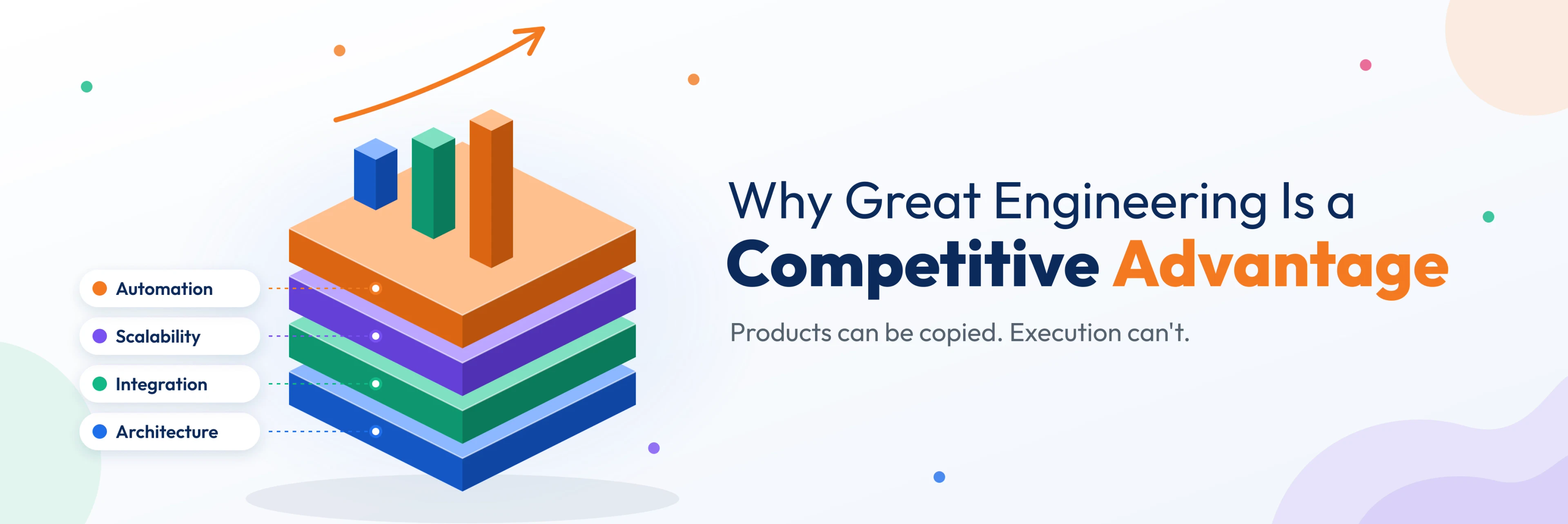
Great engineering is a competitive advantage because it determines how quickly and reliably a business can turn strategy into results. As technology becomes easier to access and copy, products and features no longer set businesses apart for long. What lasts is the ability to execute consistently, adapt quickly and scale without disruption. That ability is built through engineering.
Many organisations still see engineering as a technical function that builds software. In reality, it has become a strategic capability that shapes growth, resilience and long-term competitiveness. Businesses that recognise this treat engineering as an investment in execution, not a cost of delivery.
Key takeaways
- Technology alone rarely creates lasting differentiation; execution does.
- Most strategic goals, from AI to international expansion, succeed or fail on engineering.
- Engineering should be measured by business outcomes, not technical metrics.
- Good engineering decisions compound over time, and so do shortcuts.
Better Ideas Rarely Win. Better Execution Does.
Being first to market is not what creates market leaders. Some of the most successful businesses of the last two decades entered markets where competitors were already established:
- Amazon wasn't the first online retailer.
- Netflix didn't invent video streaming.
- Stripe wasn't the first digital payments platform.
- Monzo didn't invent the current account.
Their advantage came from executing repeatedly, improving continuously and adapting faster than everyone else. While competitors were rebuilding systems or fighting operational bottlenecks, these businesses focused on delivering value, because their engineering foundations let them move with confidence.
Execution is often mistaken for simply working faster. In practice, it means reducing the friction between a business decision and a business outcome. That friction usually comes from:
- Manual processes that should be automated
- Disconnected systems and fragile integrations
- Technical shortcuts that now slow down every change
Great engineering removes these barriers, so teams spend less time working around technology and more time creating value.
Why Does Every Competitive Advantage Become an Engineering Challenge?
Most strategic initiatives begin as business conversations about new markets, AI, customer experience or automation. As they move towards delivery, they become engineering challenges, and their success depends on whether the underlying technology can support them.
- 01Expanding into new markets: systems that handle multiple currencies, VAT and tax rules, and regional compliance.
- 02Introducing AI: trusted, accessible, well-structured data.
- 03Improving customer experience: resilient platforms and integrations that scale with demand.
- 04Automating operations: connected systems that share data reliably.
One of the most common mistakes is treating engineering as something that begins after strategy has been agreed. Choices about architecture, integration, scalability and resilience are made long before development starts, and they decide whether technology accelerates the business or becomes its biggest constraint.
Great engineering begins with making the right decisions, not simply writing better code.
How Should You Measure Great Engineering?
Engineering teams often measure success through architecture, testing, scalability and code quality. These matter, but they are not the outcomes leadership teams invest in. Executives want:
- Products delivered faster
- Fewer operational disruptions
- Higher customer satisfaction
- Technology that supports growth rather than slowing it down
This shifts the question from "Is our technology modern enough?" to "Does our technology help us compete?" In practical terms, that means asking:
- Can we launch new products without months of redevelopment?
- Can our systems integrate easily as the organisation grows?
- Can we improve operations without adding unnecessary complexity?
These are business questions, but the answers are determined by engineering.
Adaptability Is Built, Not Bought
Customer expectations evolve, regulations shift and new technologies reshape industries quickly. Businesses that respond well often look more innovative, but their agility is rarely accidental. It is usually the result of engineering decisions made years earlier.
Strong engineering foundations mean:
- New capabilities can be added without rebuilding existing systems
- Processes can be automated and technologies integrated without disruption
- Change becomes part of normal operations, not a costly transformation programme every few years
Fragile foundations mean:
- Every integration becomes a complex project
- Every product launch introduces risk
- Improvements take longer than expected, every time
Over time, businesses on fragile systems stop pursuing opportunities because change itself has become too difficult. Markets rarely wait, which is why adaptability is one of the most valuable advantages engineering can create.
Engineering Capability Creates Business Capability
Rather than thinking of engineering as a department, it is more useful to think about what it enables across the organisation:
| Engineering Capability | Business Outcome |
|---|---|
| Reliable systems | Greater customer trust |
| Scalable architecture | Confident business growth |
| Connected platforms | Operational efficiency |
| Faster delivery | Reduced time to market |
| Automation | Lower operating costs |
| Flexible technology foundations | Faster response to market change |
None of these outcomes is measured in lines of code or programming languages. They are measured in business performance, which is why engineering has become a boardroom conversation rather than purely an IT responsibility.
Great Engineering Compounds Over Time
Unlike many business investments, the impact of engineering compounds. A well-made engineering decision doesn't just solve today's problem; it makes tomorrow's decisions easier.
- 01Good decisions compound: systems stay simpler to maintain, integrations are quicker to implement and new products reach the market with less effort.
- 02Shortcuts compound too: temporary fixes become permanent, manual work increases and technical debt builds quietly until most effort goes on maintaining what exists rather than building what's next.
This is why engineering should be treated as a long-term investment rather than a project expense. Competitive advantage isn't created by one successful launch. It comes from delivering the tenth, twentieth and fiftieth initiative with the same speed and confidence as the first.
Engineering Has Earned a Seat in the Boardroom
Not long ago, leadership set the strategy and IT implemented it. That separation no longer holds, because almost every strategic decision now has a significant engineering component, including:
- Launching AI-powered services
- Expanding internationally
- Acquiring and integrating another business
- Modernising operations and customer experience
It is no longer enough to ask whether an idea makes commercial sense. Leadership teams must also understand whether their engineering foundations can support it. The businesses that consistently outperform their competitors bring engineering into strategic conversations from the start, giving architecture and integration the same weight as pricing, marketing and operations.
The Engineering Advantage Flywheel
High-performing organisations don't see engineering as a cost that delivers software. They see it as a capability that drives a cycle of continuous improvement:
- 01Better Engineering
- 02Faster Execution
- 03Better Customer Experience
- 04Business Growth
- 05Greater Investment in Innovation
- 06Even Better Engineering
Each stage reinforces the next. Faster execution lets businesses seize opportunities ahead of competitors, better experiences build loyalty, and growth funds further investment in platforms and people.
The flywheel also works in reverse. Weak engineering slows delivery, frustrates customers, limits growth and leaves fewer resources for improvement. Over time, the gap between businesses with strong foundations and those without becomes very difficult to close.
The Businesses That Win Think Beyond the Project
Many organisations still evaluate technology project by project: was it delivered on time, within budget and to scope? These questions matter, but they focus on immediate outputs rather than long-term capability. Leading organisations also ask:
- Will this decision make future change easier or harder?
- Can this platform support where the business wants to be in five years?
- Are we solving today's problem by creating tomorrow's constraint?
Success, from this perspective, isn't just whether a project was completed. It's whether the business became faster, more resilient and better placed to compete afterwards. When engineering is viewed this way, every technology decision becomes a business decision.
Conclusion
Products can be copied, features can be replicated and AI is becoming widely available. What remains hard to replicate is an organisation's ability to execute consistently, adapt quickly and scale without losing momentum. That ability is built through great engineering, measured not by frameworks or elegant architecture but by business outcomes.
At BSP Technologies®, this is how we approach every engagement. Whether we're modernising legacy systems, integrating complex platforms or building new digital products, the objective isn't simply to deliver software. It's to create engineering foundations that help businesses execute strategy faster, adapt with confidence and build lasting competitive advantage.
Technology will keep evolving, and today's innovation will become tomorrow's standard. The businesses that lead won't necessarily have the newest technology. They'll have the engineering capability to turn change into opportunity.
Ready to Build an Engineering Advantage?
If your technology is slowing innovation, limiting growth or making every change harder than it should be, the issue may not be your software. It may be the engineering foundations beneath it. Talk to BSP Technologies® about modernising legacy systems, integrating your technology estate or building scalable digital platforms that support your business today and prepare it for tomorrow.
Talk to Our TeamFrequently Asked Questions
Yes. Strong engineering foundations help businesses of every size scale efficiently, reduce operational risk and avoid technology decisions that become barriers to growth. Investing early usually costs far less than fixing problems later.
Technical metrics are useful internally, but leadership should measure engineering through outcomes: faster time to market, improved reliability, lower operating costs, less downtime, higher customer satisfaction and the ability to introduce change with confidence.
Software development focuses on delivering applications or features. Great engineering takes a broader view, considering architecture, integration, scalability and maintainability, so that technology supports long-term business objectives rather than only immediate project requirements.
As early as possible. Expansion, digital transformation, AI adoption, acquisitions and operational change all have engineering implications. Involving engineering early helps organisations spot opportunities, reduce risk and make better-informed decisions.
No. Every organisation now depends on technology to serve customers, run operations and stay competitive. In manufacturing, healthcare, retail, financial services and logistics alike, engineering capability has become a key driver of business performance.