
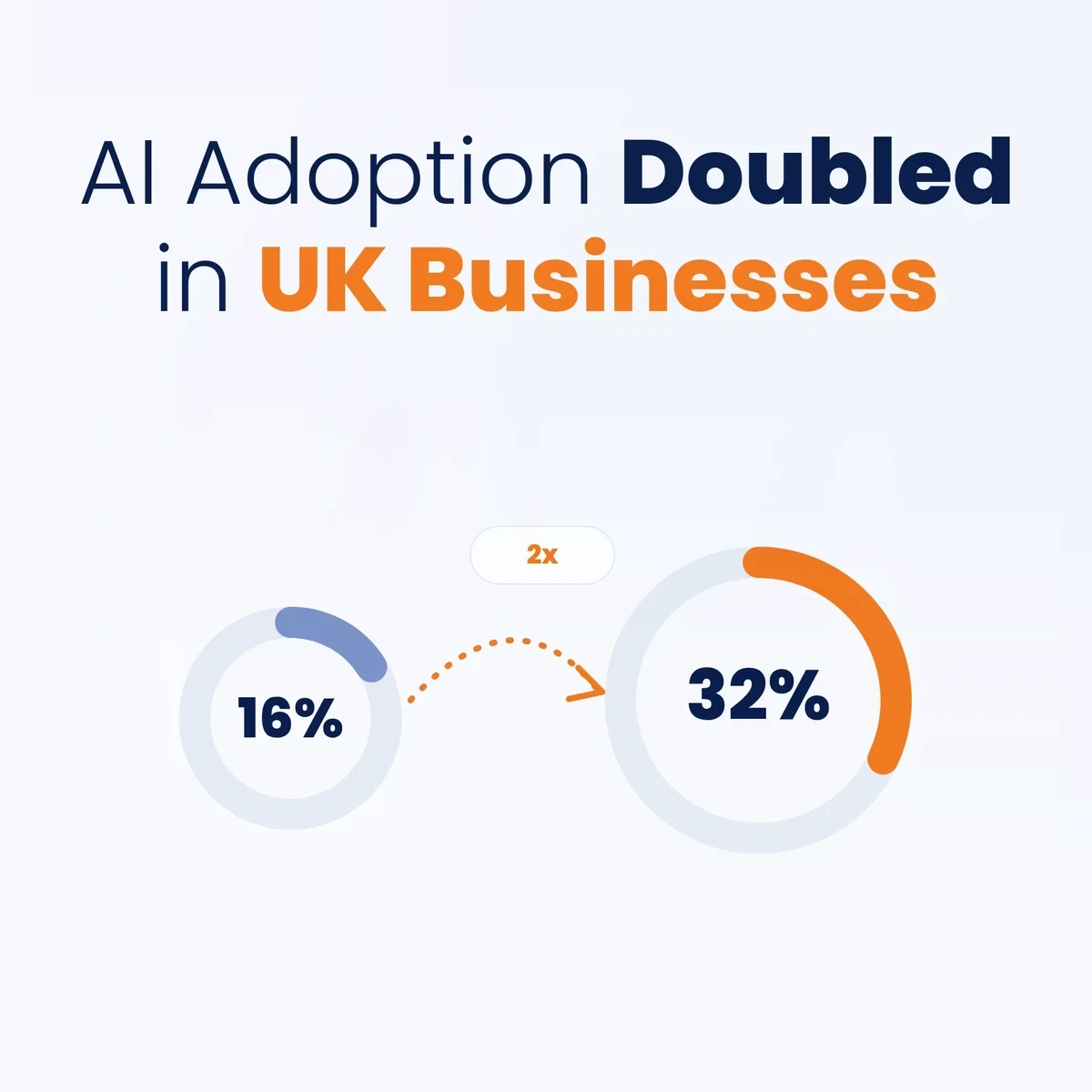
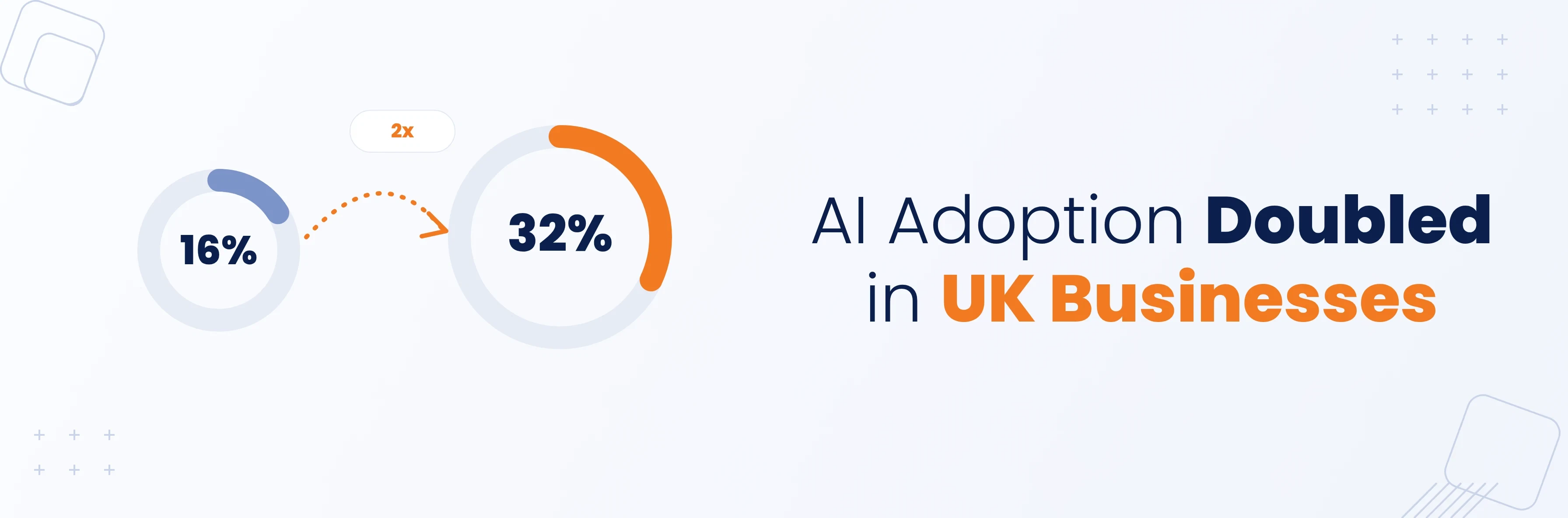
Short answer: The UK government's AI Adoption Survey 2026 found that 32% of UK businesses now use at least one AI technology, double the 16% recorded in 2025. But the same survey shows most firms are stuck on skills and unclear use cases, not cost. The fix is to pick one workflow, check the data, and ship a working feature to real users quickly.
That last part is where most projects go wrong. Not the model. Not the budget. The decision about what to build first.
What did the UK AI Adoption Survey 2026 find?
The survey, commissioned by the Department for Science, Innovation and Technology (DSIT) and published on GOV.UK on 29 October 2026, interviewed 3,503 UK businesses between January and April 2026. Its headline is simple: "AI adoption doubled since 2025." The key numbers:
- 32% of UK businesses used at least one AI technology in 2026, up from 16% in 2025.
- 52% of larger firms use AI, and 61% of information and communication businesses.
- 65% expect their AI budgets to increase.
- But only 14% rate AI as of high or critical importance to their business today.
So adoption is up, budgets are rising, and yet most firms don't see AI as central. That gap is the real story.
Why are UK businesses stalling on AI?
The biggest barrier isn't cost. In the survey, a lack of skills, expertise or understanding of use cases was cited by 67% of current adopters and 78% of businesses planning to adopt. A missing business case or proven return was cited by 65%, mostly by non-adopters. Cost was described mainly as the time and effort to implement, not the price of tools.
The skills gap is really a scoping gap
Most SMEs don't need an in-house machine-learning team. They need someone who can look at their operation and say: this workflow, with this data, will pay back. That's a scoping skill, not a research skill. Without it, teams either buy a tool nobody uses or commission a six-month project with a vague brief.
"No clear business case" means nobody has picked one workflow
The survey found that 50% of adopters report a productivity increase, though the report describes it as modest. On costs, 24% saw operating costs fall, while 64% saw no immediate effect. Spreading AI thinly across everything produces thin results. A single workflow with a measured baseline produces a business case you can defend.
Accuracy worries are a design problem, not a reason to wait
Concerns about bias and accuracy were cited by 56% of adopters and 60% of planners. That's reasonable. The answer is designing human review into the workflow from day one. Encouragingly, 81% of businesses already apply some human oversight to AI outputs. Build that check in, and accuracy becomes a managed risk rather than a blocker.
Off-the-shelf AI tools or AI built into your own systems?
Short answer: both have a place. Use off-the-shelf tools for generic work. Build AI into your own system when the value depends on your own data, customers or process. The survey shows firms are planning both: 61% plan to invest in off-the-shelf applications, 57% in automating tasks, and 54% in embedding AI into existing systems.
| Off-the-shelf AI tool | AI built into your own system | |
|---|---|---|
| Best for | Drafting, summarising, meeting notes | Quoting, triage, matching, forecasting on your data |
| Data access | Whatever you paste in | Direct, permissioned access to your records |
| Differentiation | Same as your competitors | Specific to how you work |
| Control | Vendor's roadmap | Your roadmap, your guardrails |
| Typical risk | Low adoption, shadow use | Poor scoping, weak foundations |
Most administrative use is already covered by tools: the survey found administration (81%), marketing (71%) and IT (66%) are the most common uses. The competitive edge sits in the second column.
How do you choose the first AI feature worth building?
Use five checks. If a candidate fails one, park it.
- 01Pick one painful, repeated workflow. Something your team does daily or weekly that costs real hours, such as triaging enquiries, preparing quotes or matching documents.
- 02Check the data exists and is reachable. The information has to live in a system you control, with an API or a clean export. If it doesn't, that's your first project.
- 03Define success in one number. Hours saved a week, response time, error rate. Record today's baseline.
- 04Design the human check. Decide where a person approves AI output before it reaches a customer or your accounts.
- 05Ship to real users, then decide. Put it in front of the people who do the work. Measure. Keep, extend or stop.
If step 2 fails because your core system is old or undocumented, you may need to modernise the system underneath first. An independent health check will tell you quickly whether it can take an AI feature.
What does a 30-day fixed-price AI sprint look like?
A sprint is a fixed scope, a fixed price and a fixed deadline: one working, deployed AI feature or MVP in 30 days. It suits funded founders and SME teams who want proof before committing to a bigger build.
Before you spend anything: the scoping call
Nirav personally scopes every sprint. The rule is plain: if it doesn't fit the sprint, we tell you before you spend anything. That honesty is the point. A fixed price only works when the scope is real.
The build: one workflow, real data, real users
The sprint takes the single workflow from your five checks and builds it end to end, connected to your actual data, with the human review step designed in, deployed where your team or customers will use it. Not a slide deck. Not a demo on sample data.
After day 30: keep, extend or stop
You measure against the baseline you set. If it pays back, you extend it or add the next workflow, often with a dedicated team. If it doesn't, you've spent a fixed, known amount to learn that, far cheaper than six months of drift.
Why we work this way at BSP
BSP Technologies® has been building software since 2013. We've learned that the expensive mistakes happen before the first line of code, which is why Nirav reviews every project at kickoff, personally. A few things matter if you're about to trust someone with your first AI build:
- 01Continuity. Our team retention is 95%, against an industry average of 30-40%. The engineers who start your sprint are the ones who extend it.
- 02Repeat work. 80% of our clients come back for another engagement, and we're rated 4.9★ on Clutch.
- 03Scale and foundations. Platforms we've built serve more than 300,000 users, and we've modernised a 15-year-old manufacturing system with zero downtime. AI is only as good as the system it sits on.
We'll tell you what you need to hear, not what you want to hear. Sometimes that's "build it in 30 days". Sometimes it's "fix the foundation first".
Want a straight answer on what your first AI feature should be? Book a 30-minute call with Nirav and see how a 30-day fixed-price sprint would work for you.
Frequently Asked Questions
According to the DSIT AI Adoption Survey 2026, published on GOV.UK in October 2026, 32% of UK businesses were using at least one AI technology, up from 16% in 2025. Adoption was higher among larger firms, at 52%.
Skills. In the 2026 survey, a lack of skills, expertise or understanding of use cases was cited by 67% of AI adopters and 78% of businesses planning to adopt. A lack of a clear business case was cited by 65%, mainly by non-adopters.
Use off-the-shelf tools for generic tasks such as drafting and summarising. Build AI into your own system when the value depends on your own data, workflow or customers. Many firms do both: 61% plan to invest in off-the-shelf apps and 54% in embedding AI into existing systems.
Yes, if the scope is one workflow, the data already exists and success is defined up front. A fixed-price sprint only works when the scope is honest, so anything that does not fit should be flagged before any money is spent.
Then the first job is the foundation, not the AI. An independent health check will tell you whether the system can take an AI feature, needs phased modernisation first, or should be replaced.
Sources
1. Department for Science, Innovation and Technology, AI adoption survey report 2026: executive summary, GOV.UK, published 29 October 2026: GOV.UK executive summary
2. AI adoption survey 2026 (publication page and methodology), GOV.UK: GOV.UK publication page
3. Artificial intelligence adoption research 2026 (full report, PDF), GOV.UK: Full report (PDF)