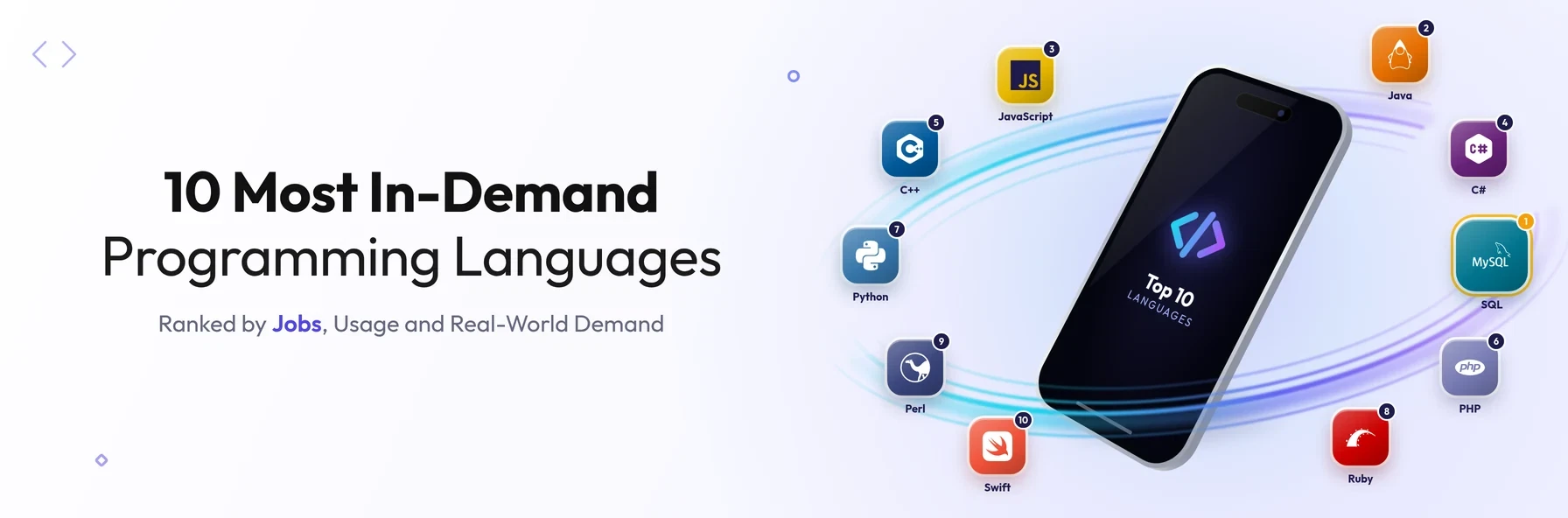
In short: The most in-demand programming languages in 2018 are SQL, Java, JavaScript, C#, C++, PHP, Python, Ruby on Rails, Perl and Swift. SQL underpins almost every business application, Java and C# power enterprise systems, JavaScript runs the web, PHP powers much of it, Python is rising fast for data and machine learning, and Swift leads iOS.
Whether you are choosing a technology stack for a new product or starting a career in software development, the programming language you pick matters. It affects how quickly you can build, how easily you can hire developers, how well your software scales, and which opportunities are open to you.
The landscape keeps moving. Python is growing quickly thanks to data science and machine learning, JavaScript now runs on servers as well as in browsers, and newer languages such as Swift, Go and Kotlin are gaining ground. Older languages such as Perl, meanwhile, are slowly declining.
This guide explains the 10 most in-demand programming languages in 2018, what each one is used for, and how to choose the right one for your project or career.
How We Chose These Languages
There is no single official ranking of programming languages. This list is based on how often each language appears in job postings on Indeed.com, a widely used indicator of what employers are looking for. It also reflects other widely followed sources, such as the Stack Overflow Developer Survey and the TIOBE Index, along with our own experience of what businesses are building. Rankings vary between sources and change every year, so the order below is a guide rather than a strict league table.
The 10 Most In-Demand Programming Languages at a Glance
| Language | Best known for | Typical uses |
|---|---|---|
| SQL | Working with data | Querying and managing relational databases |
| Java | Enterprise systems and Android | Banking, large business systems, native Android apps |
| JavaScript | The language of the web | Interactive websites, web apps, Node.js back ends |
| C# | The Microsoft and .NET ecosystem | Enterprise software, web applications, Windows apps, Unity games |
| C++ | High-performance software | Game engines, browsers, operating systems, embedded systems |
| PHP | Websites and web apps | WordPress, WooCommerce, Magento, Laravel applications |
| Python | Data, machine learning and automation | Data analysis, machine learning, web back ends, scripting |
| Ruby on Rails | Rapid web development | Start-up products and web applications |
| Perl | Scripting and system administration | System scripts, text processing, legacy systems |
| Swift | Apple platforms | iPhone, iPad, Mac and Apple Watch apps |
1. SQL
SQL (Structured Query Language) is the standard language for storing, retrieving and managing data in relational databases such as Microsoft SQL Server, PostgreSQL, MySQL and Oracle. These databases run large organisations, small businesses, hospitals, banks and universities alike, so it is no surprise that SQL tops the list.
SQL is everywhere, including on mobile devices: SQLite, a lightweight SQL database, is built into both Android and iOS. Almost every developer, data analyst and reporting specialist benefits from SQL skills.
Best for: data management, reporting, analytics and any application that stores business data.
2. Java
Java was first released by Sun Microsystems in 1995 and is now maintained by Oracle, which acquired Sun in 2010. Its promise of "write once, run anywhere" has made it a long-standing favourite for large, reliable business systems.
Java powers enterprise applications in banking, insurance, retail and government, often using the Spring framework. It is also the main language for native Android apps, although Google added official support for Kotlin in 2017.
Best for: large enterprise systems, back-end services and native Android apps.
3. JavaScript
JavaScript, which should not be confused with Java, is the programming language of the web. It runs in every major browser and brings web pages to life, from forms and animations to complete web applications.
With Node.js, JavaScript also runs on servers, so teams can use one language across the front end and back end. Popular frameworks such as React, Angular and Vue are built around it, and React Native uses it to build mobile apps.
Best for: web front ends, full-stack web development and real-time applications.
4. C#
C# (pronounced "C sharp") was developed by Microsoft and released in 2000 as part of the .NET Framework. It builds on the ideas of C and C++, with a cleaner, modern syntax. With .NET Core, released as open source in 2016, C# applications can now also run on macOS and Linux.
C# is widely used for enterprise software, web applications with ASP.NET, cloud services on Microsoft Azure and Windows desktop applications. It is also the main language of the Unity game engine and, through Xamarin, can be used to build mobile apps.
Best for: businesses in the Microsoft ecosystem, enterprise applications and game development with Unity.
5. C++
C++ was created by Bjarne Stroustrup at Bell Labs in the early 1980s as an extension of the C language. It gives developers fine control over memory and performance, and it continues to evolve, with the C++17 standard published in 2017.
C++ remains essential for performance-critical software such as game engines, web browsers, operating systems, embedded systems and financial trading platforms.
Best for: high-performance applications, games and systems software.
6. PHP
PHP (PHP: Hypertext Preprocessor) was created by Rasmus Lerdorf in the mid-1990s as a set of tools for maintaining his personal home page. It has since become one of the most widely used server-side languages on the web.
PHP powers WordPress, WooCommerce and Magento, along with modern frameworks such as Laravel. Since PHP 7, released in 2015, it has become significantly faster, making it a strong choice for content-driven websites, e-commerce stores and business web applications.
Our guides on what is Laravel and WooCommerce on WordPress explain two of its most popular uses.
Best for: WordPress sites, e-commerce, and web applications built with Laravel.
7. Python
Python was created by Guido van Rossum and first released in 1991. It is named after the comedy group Monty Python. Its clear, readable syntax makes it one of the easiest languages for beginners, yet it is powerful enough for experienced professionals.
Python is growing rapidly as the leading language for data science and machine learning, with libraries such as pandas, scikit-learn and TensorFlow. It is also widely used for automation and scripting, and for web development with frameworks such as Django and Flask.
Best for: data analysis, machine learning, automation and web back ends.
8. Ruby on Rails
Ruby is a general-purpose programming language created by Yukihiro Matsumoto in the mid-1990s. Rails is the web framework built on Ruby, released in 2004. Together, Ruby on Rails is known for rapid development: it needs less code than many alternatives and comes with a large library of ready-made components, known as gems.
Ruby on Rails is popular with start-ups and powers well-known platforms such as GitHub, Shopify and Airbnb.
Best for: building web products quickly, especially for start-ups.
9. Perl
Perl was created by Larry Wall in 1987. Both Perl 5 and Perl 6 remain in use, particularly among system and network administrators, where Perl often serves as a "glue language" connecting different software components.
As with many older languages, demand for Perl is gradually declining as newer languages such as Python take over many of its traditional tasks. However, a large amount of existing software still depends on it.
Best for: system administration, text processing and maintaining existing Perl systems.
10. Swift
Apple introduced Swift in 2014 as a modern, safe and fast language for iOS and macOS development, and made it open source in 2015. It is steadily replacing Objective-C as the main language for iPhone, iPad, Mac, Apple Watch and Apple TV apps.
Swift's clean syntax and safety features make apps easier to build and maintain, and many companies have adopted it for their iOS apps.
Best for: native iOS and Apple platform apps.
Also Worth Knowing: Go, Kotlin and TypeScript
- 01Go, created at Google and released in 2009, is simple, fast and efficient at running many tasks at once. Tools such as Docker and Kubernetes are written in Go, and it is increasingly popular for cloud services.
- 02Kotlin, created by JetBrains, became an officially supported language for Android at Google I/O 2017. It is more concise and safer than Java while remaining fully compatible with existing Java code.
- 03TypeScript, developed by Microsoft, adds type checking to JavaScript. It catches many errors while code is being written and is used by the Angular framework.
How to Choose the Right Programming Language
For your business or product
Choose a language based on what you are building, not on popularity alone:
- 01Web applications and portals: JavaScript on the front end, with PHP (Laravel), Python, Ruby on Rails, Node.js, C# or Java on the back end.
- 02Mobile apps: Swift for iOS, Java or Kotlin for Android, or React Native (JavaScript) or Xamarin (C#) for both from one codebase.
- 03Data and machine learning products: Python, together with SQL.
- 04Enterprise systems: Java or C#.
- 05Websites and e-commerce: PHP with WordPress, WooCommerce or Magento.
Also consider the availability of developers, your existing systems, long-term support and how easily the technology will scale.
For your career
Python and JavaScript are excellent first languages, because they are beginner-friendly and widely used. From there, specialise based on the area that interests you most, such as web, mobile, data or enterprise development. Choose the path that motivates you, as long-term interest matters more than following trends.
Conclusion
There is no single "best" programming language. Each has strengths for particular types of projects. SQL underpins data, Java and C# run enterprise systems, JavaScript powers the web, PHP drives many websites and online stores, Python is rising fast in data and machine learning, and Swift leads iOS development.
For businesses, the right choice depends on what you are building, how it needs to scale and who will maintain it. For developers, the best language is the one that matches your goals and keeps you motivated to keep learning.
Not sure which technology stack is right for your next project?
Schedule a free consultation with BSP Technologies, and we will help you choose the right languages and frameworks for your goals.
Schedule a Free ConsultationFrequently Asked Questions
Based on job postings, SQL, Java and JavaScript are the most in-demand programming languages in 2018. SQL is needed for almost every business application that stores data, Java dominates enterprise systems and Android, and JavaScript powers the web. C#, C++, PHP and Python also remain in high demand.
Python is often recommended for beginners because its syntax is clear and readable, and it is useful in many fields. JavaScript is another strong first choice for anyone interested in building websites, because it produces visible results quickly in the browser.
Python is the leading language for data science and machine learning, thanks to libraries such as scikit-learn, TensorFlow and pandas and a large research community. Other languages, such as C++, are used for performance-critical parts, but most machine learning work starts in Python.
Swift is used for native iOS apps, and Java or Kotlin for native Android apps. For apps that run on both platforms from one codebase, teams commonly use JavaScript with React Native, or C# with Xamarin. The right choice depends on budget, performance needs and design requirements.
Yes. PHP powers a large share of the web, including WordPress, WooCommerce and Magento, and modern frameworks such as Laravel make it a strong choice for web applications. Since PHP 7, it is also significantly faster, and it is supported by a large community and plenty of experienced developers.