Short answer: UK employers cut back on permanent hiring in October 2026, according to the KPMG and REC UK Report on Jobs published on 9 November. If your headcount is frozen but your roadmap isn't, a dedicated software development team gives you stable engineering capacity without new permanent hires. The thing to judge it on is retention, not day rate.
What did the November 2026 Report on Jobs actually say?
The latest KPMG and REC UK Report on Jobs, based on a survey of around 400 UK recruitment consultancies between 12 and 26 October, found that permanent placements fell for the first time in four months. Recruiters said employers were delaying or scaling back hiring because of uncertainty and rising costs. Temporary billings also dropped, for the first time since March. (KPMG/REC, 9 Nov 2026)
There is a catch for technology leaders. The same report says demand for permanent staff rose in six of ten job categories, led by IT & Computing. It also notes that starting pay rose partly because good candidates were often in short supply.
So the picture is not "nobody needs engineers". It's this: businesses are nervous about adding permanent cost, while still competing hard for the engineers they do need.
The contract market is telling a similar story. ContractorUK reported that the REC's index for temporary tech staff demand hit 53.7 in September 2026, its strongest reading since January 2023 (anything above 50 means growth). In the same article, Adzuna data showed overall IT vacancies down 11.1% year on year, while job adverts mentioning AI rose to 25,000 from 14,700 a year earlier. (ContractorUK, 3 Nov 2026)
In plain terms: fewer generic roles, more demand for specific skills, and more of it being met on flexible terms.
Why a hiring pause hits product companies harder than most
A hiring pause in a sales team slows growth. A hiring pause in an engineering team stops things.
Most scale-up roadmaps are approved months in advance. The board expects the new pricing engine, the integration a big customer asked for, or the AI feature a competitor just shipped. When the permanent hire that was meant to deliver it gets pushed back a quarter, the work doesn't disappear. It lands on an internal team that is already at capacity.
That's when the damage starts. Bug fixes slip. Technical debt builds. Your best engineer starts taking recruiter calls because they're tired of covering two jobs.
Here's the uncomfortable truth: waiting is a decision too, and it has a cost. It just doesn't show up on the hiring budget.
What are your options when you can't add permanent headcount?
When permanent headcount is off the table, a CTO really has three choices.
Option 1 - Wait for confidence to return
Sensible if the roadmap item is genuinely optional. Risky if it's tied to a customer commitment or revenue. You also keep paying for the hidden cost above.
Option 2 - Contractors
Good for a defined, short burst of specialist work. The REC data suggests demand is rising here, which tends to push day rates up. The bigger issue is continuity. Contractors are, by design, temporary. When they leave, the knowledge of why things were built a certain way leaves with them.
Option 3 - A dedicated development team
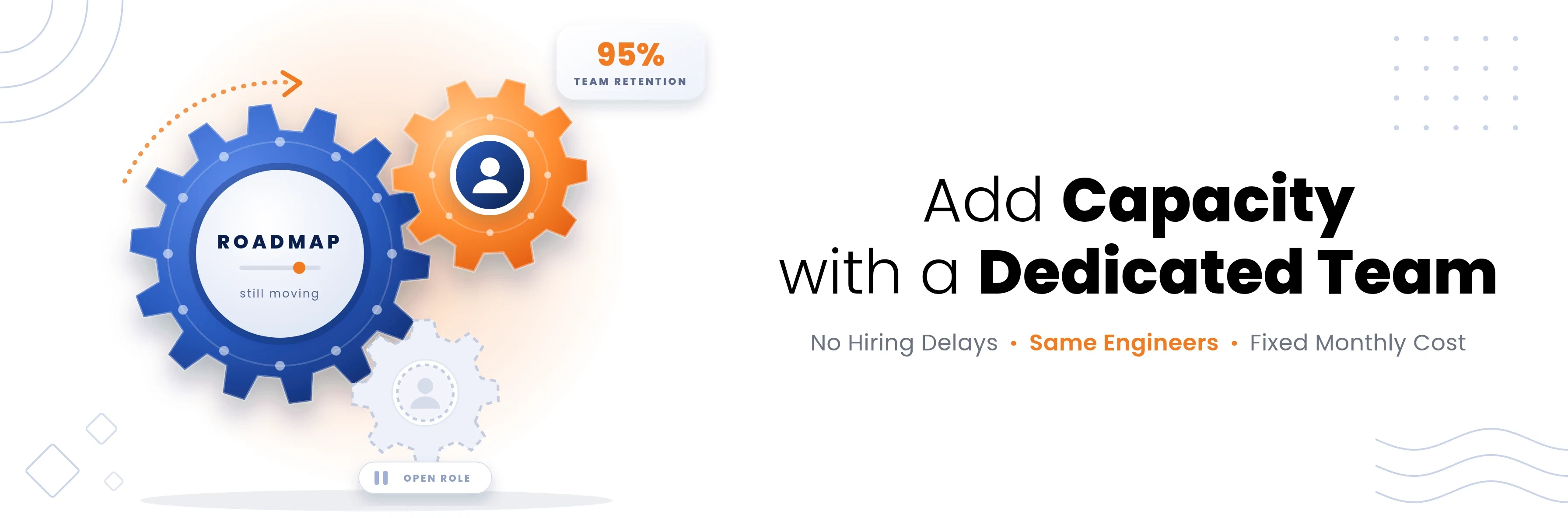
A dedicated software development team is a stable group of engineers who work only on your product, inside your tools and sprint rhythm, on a monthly retainer. They join your standups. They care about your roadmap. And, if the provider is any good, the same people are still there a year later.
| Wait | Contractors | Dedicated team | |
|---|---|---|---|
| Speed to start | None | Fast | Fast |
| Continuity on your codebase | Your team only | Low | High (if retention is high) |
| Cost predictability | Hidden costs | Variable day rates | Fixed monthly |
| Who owns the knowledge | Your team | Leaves with the contractor | Builds up over time |
| Best for | Optional work | Short specialist bursts | Ongoing roadmap delivery |
Comparison reflects BSP's view based on our own delivery experience.
How to tell a dedicated team that stays from one that churns
This is where most outsourcing goes wrong. The model is fine. The provider churns its people.
Before you sign with anyone, BSP included, ask these five questions:
- 01What is your team retention rate? Get a number. If they can't give one, that's your answer.
- 02What happens when an engineer leaves mid-project? Listen for a handover process and overlap, not "we'll replace them quickly".
- 03Will the engineers work in our tools and attend our standups? If the answer is a weekly status email, it's not a dedicated team.
- 04Who owns the code, the repositories and the access? It should be you, from day one.
- 05Who senior reviews the work? You want a named, senior person accountable for architecture, not a junior project manager.
Retention is the one that matters most. Every time an engineer rotates off your product, you pay for weeks of re-onboarding and lose context that never fully comes back.
What this looks like at BSP
I'll be direct about why we built BSP around this model.
Our team retention is 95%, against an industry average of 30-40%. That's the reason 80% of our clients come back for further work. The engineers who start on your product are, almost always, the engineers who are still on it.
A few examples of what that continuity makes possible:
- 01Tyre Channel UK has worked with us for ten years. We took the business from paper to a fully digital platform, with more than £10M in measurable business impact and no delivery miss.
- 02Embedded engineering. A senior BSP engineer has worked embedded in a global design-software company's product team, inside their own engineering workflow and standards.
- 03Scale. Platforms we've built serve 300,000+ users.
I personally review every project at kickoff. That's where architecture and scope get decided, and it's too important to delegate.
We're rated 4.9★ on Clutch, and we've been doing this since 2013.
We'll also tell you if a dedicated team is the wrong answer. If your need is a single, well-defined build, a fixed-scope project is often better value. I tell you what you need to hear, not what you want to hear.
If your roadmap is waiting on a hire that isn't coming this quarter, let's talk it through. Book a 30-minute call with Nirav or see how our dedicated remote engineering team works.
Running an agency rather than a product company? Our white-label development for agencies uses the same team model behind your brand. Need one product shipped fast instead? See the 30-day fixed-price sprint.
Book a 30-minute call with Nirav
Your roadmap shouldn't wait on a hire that isn't coming this quarter.
Book a 30-minute call with NiravFrequently Asked Questions
A dedicated software development team is a group of engineers who work only on your product, in your tools and your sprint rhythm, for an ongoing monthly fee. Unlike a project agency, the team stays with your codebase over time, so knowledge builds up rather than walking out the door at the end of a contract.
It is usually more predictable rather than simply cheaper. You avoid recruitment fees, long notice periods and the cost of a bad hire, and you can scale up or down with the roadmap. The real saving comes from continuity: a team that stays avoids the re-onboarding cost every time an engineer leaves.
Contractors and staff augmentation fill individual seats, often for short terms. A dedicated team is a stable unit that owns delivery on your codebase month after month. The difference shows up after six months: contractors have usually rotated, while a dedicated team still knows why each decision was made.
Typically far faster than a permanent hiring cycle, because you are not running a recruitment process for each seat. The honest answer depends on your stack and how well your codebase is documented, which is why BSP starts with a 30-minute call and a kickoff reviewed personally by the founder.
Ask for the provider's team retention rate, how they handle an engineer leaving mid-project, who owns the code and access, whether engineers join your standups and tools, and who senior reviews the work. Retention is the single most telling number, because churn is where most outsourced teams fail.
Sources
1. KPMG and REC, UK Report on Jobs, November 2026 (published 9 November 2026; survey data 12-26 October 2026): KPMG/REC press release
2. ContractorUK, "AI powers IT contractor demand in September 2026 to highest level since 2023", Simon Moore, 3 November 2026 (reporting REC temporary tech staff index and Adzuna data): ContractorUK article
BSP figures (95% retention, 80% repeat clients, 4.9★ Clutch, 300,000+ users, Tyre Channel UK partnership) are BSP Technologies' own data.