
Every business relies on information moving quickly and accurately. Products are scanned before dispatch, raw materials are weighed during production, machines generate performance data, and inventory moves through warehouses every minute of the day. Yet in many organisations, this information still travels manually between devices and business systems.
A barcode scanner captures data, but someone updates the ERP later. A weighing scale records measurements, but production teams enter them manually. These extra steps slow operations, increase the risk of errors, and prevent businesses from having a complete view of what's happening.
As organisations invest in automation, AI, and digital transformation, disconnected systems become a bigger challenge. Modern businesses need technology that works together, not independently. That's why hardware and software integration has become an essential part of building efficient, scalable operations.
What is Hardware and Software Integration?
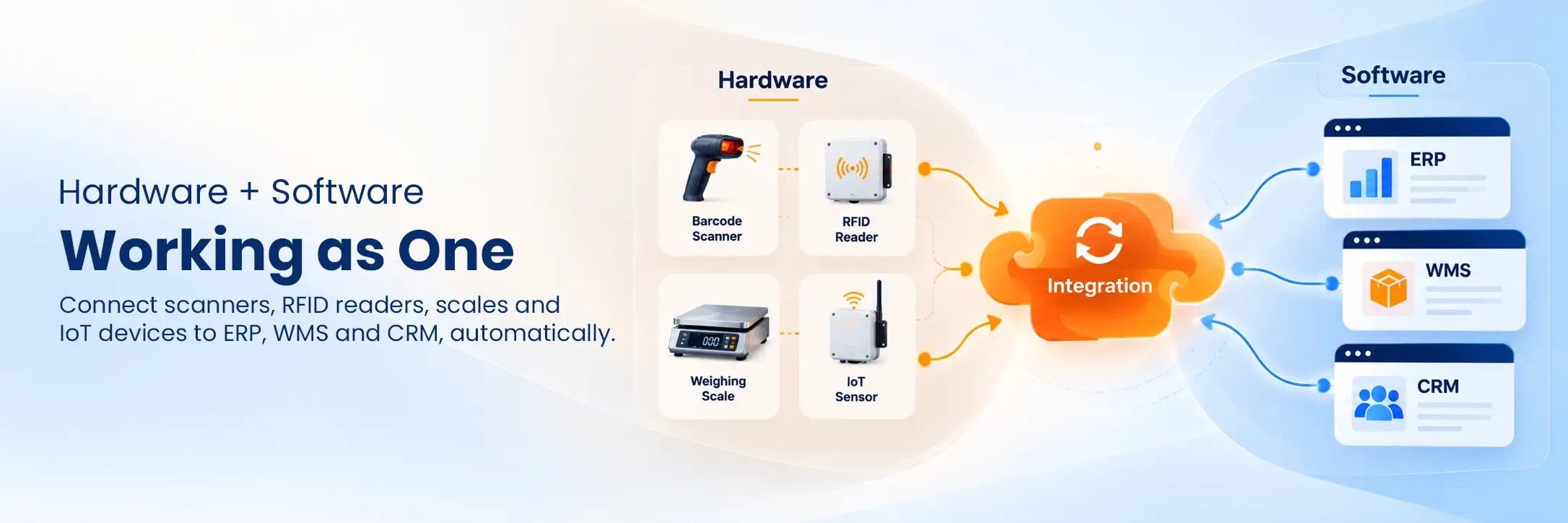
Hardware and software integration is the process of connecting physical devices with business applications so they automatically exchange information.
Instead of operating as standalone tools, devices such as barcode scanners, RFID readers, digital weighing scales, BLE devices, IoT sensors, and industrial equipment communicate directly with ERP systems, Warehouse Management Systems (WMS), CRMs, and other enterprise applications.
Without integration, every device creates another manual task. Employees capture information on one system before entering it into another. Over time, this creates delays, duplicate work, and inconsistent data across departments.
Integration removes those unnecessary steps by allowing information to flow automatically wherever it's needed.
Think of it this way: hardware captures information, software processes information, and integration ensures information moves automatically between them.
Rather than simply connecting devices, integration creates a connected business where operational data supports faster decisions, better visibility, and more efficient workflows.
| Without Integration | With Integration |
|---|---|
| Manual data entry | Automatic data synchronisation |
| Higher risk of human error | Improved data accuracy |
| Delayed reporting | Live operational visibility |
| Disconnected systems | Connected business workflows |
| Slower decision-making | Faster, data-driven decisions |
Why Businesses Are Prioritising Hardware and Software Integration
The growing demand for integration isn't driven by technology trends. It's driven by business expectations.
Customers expect faster service. Supply chains operate continuously. Management teams need accurate operational information without waiting for manual reports. At the same time, businesses are under constant pressure to improve productivity while controlling costs.
Disconnected systems make these goals difficult to achieve.
When employees manually move information between applications, productivity suffers. Different departments often work with different versions of the same data, making decision-making slower and less reliable.
Integration solves these problems by creating a single flow of information across the business. Clean, connected data also provides the foundation for automation, AI, analytics, and future digital initiatives.
One pattern we often see is businesses investing in better hardware without improving the underlying workflow. A newer barcode scanner or RFID reader rarely delivers significant value on its own. The real improvement comes when those devices are connected to ERP, warehouse management, manufacturing, or custom business systems.
Why Businesses Are Investing in Integration
- Reduce manual work
- Improve data accuracy
- Increase operational efficiency
- Eliminate duplicate processes
- Improve visibility across departments
- Build a stronger foundation for automation and AI
At BSP Technologies, we've found that successful integration projects start with understanding business workflows rather than simply connecting devices. Whether integrating barcode scanners, RFID readers, digital weighing systems, or industrial equipment, the goal is always the same: capture information once and make it available wherever the business needs it.
Where Hardware and Software Integration Creates Business Value
The benefits of hardware and software integration extend across industries, but the objective remains the same: eliminate manual processes, improve data accuracy, and ensure information is available wherever it's needed.
Manufacturing
Manufacturers rely on accurate production data to maintain quality, optimise output, and reduce downtime. Integrating production equipment, barcode scanners, weighing systems, and sensors with ERP or Manufacturing Execution Systems (MES) allows production data to flow automatically into business applications.
This reduces manual reporting, improves inventory accuracy, and helps teams identify issues before they affect productivity.
Warehousing and Logistics
Warehouses generate thousands of transactions every day. Without integration, inventory updates often depend on manual entries, creating delays and stock discrepancies.
Connecting barcode scanners, RFID readers, and warehouse devices with Warehouse Management Systems (WMS) and ERP software ensures inventory is updated instantly as products move through the supply chain. The result is faster order fulfilment, improved stock accuracy, and greater operational visibility.
Retail
Retail businesses manage inventory, sales, payments, and customer information across multiple systems. When these systems work independently, employees spend valuable time updating records while customers experience stock inconsistencies and fulfilment delays.
By integrating point-of-sale systems, barcode scanners, inventory software, and eCommerce platforms, every transaction updates inventory automatically, creating a smoother experience for both staff and customers.
Industrial IoT and Connected Operations
IoT devices continuously collect information about equipment performance, production efficiency, energy consumption, and asset utilisation. However, that data has limited value if it remains isolated.
Integrating IoT devices with ERP systems, maintenance software, and analytics platforms transforms raw operational data into meaningful business insights. Instead of simply monitoring equipment, businesses can support predictive maintenance, improve planning, and make faster operational decisions.
The value doesn't come from owning more devices. It comes from ensuring those devices work together as part of a connected business process.
Common Mistakes Businesses Make
Many integration projects fail because organisations focus on connecting devices instead of improving business processes. Technology alone doesn't create efficiency. Well-designed workflows do.
Before choosing hardware or software, businesses should understand how information should move across their operations. Once that workflow is clear, selecting the right integration approach becomes much easier.
At BSP Technologies, we've found that successful integration starts with understanding the business rather than the technology. Once workflows are defined, integrating barcode scanners, RFID readers, digital weighing systems, BLE devices, or enterprise software becomes a strategic investment that improves efficiency across the organisation.
Conclusion
Hardware and software integration is no longer just about connecting devices. It's about connecting the way a business operates.
When information flows automatically between physical hardware and business software, organisations reduce manual work, improve data accuracy, and gain the visibility needed to make faster, more informed decisions. More importantly, they create a technology foundation that supports automation, AI, and future business growth.
The businesses that gain the greatest value from technology aren't necessarily the ones investing in the most devices. They're the ones ensuring every device, application, and process works together as a connected system.
Looking to Connect Your Hardware and Software?
We help organisations integrate barcode scanners, RFID readers, weighing systems, BLE devices, Industrial IoT solutions, and enterprise software to build connected, scalable operations. Get in touch to discuss your integration requirements.
Talk to Our TeamFrequently Asked Questions
Hardware and software integration connects physical devices such as barcode scanners, RFID readers, weighing systems, and IoT devices with business software so information moves automatically between systems, eliminating manual data entry and improving operational efficiency.
Manufacturing, warehousing, logistics, retail, healthcare, and industrial businesses benefit the most, particularly those that rely on multiple devices to capture operational data throughout the day.
In many cases, yes. Existing hardware can often be integrated with ERP, WMS, CRM, and custom business applications using APIs, middleware, or custom integration solutions, allowing businesses to maximise their existing technology investments.
If your team manually enters data into multiple systems, experiences duplicate records, struggles with inventory accuracy, or lacks visibility across operations, hardware and software integration can significantly improve efficiency and data accuracy.
The timeline depends on the number of devices, existing systems, and integration complexity. Smaller projects may take a few weeks, while enterprise-wide integrations are typically delivered in phases to minimise disruption while ensuring business continuity.