
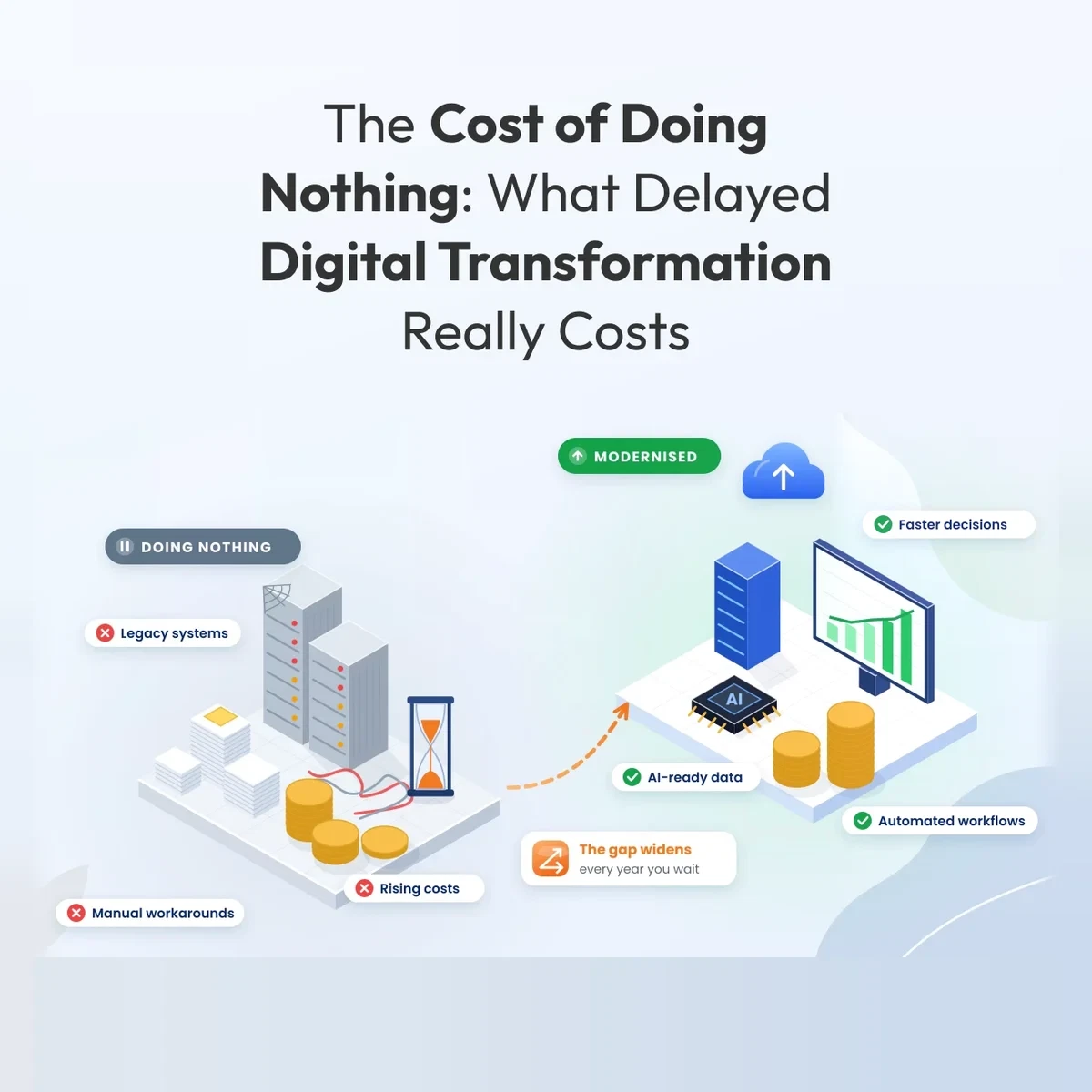
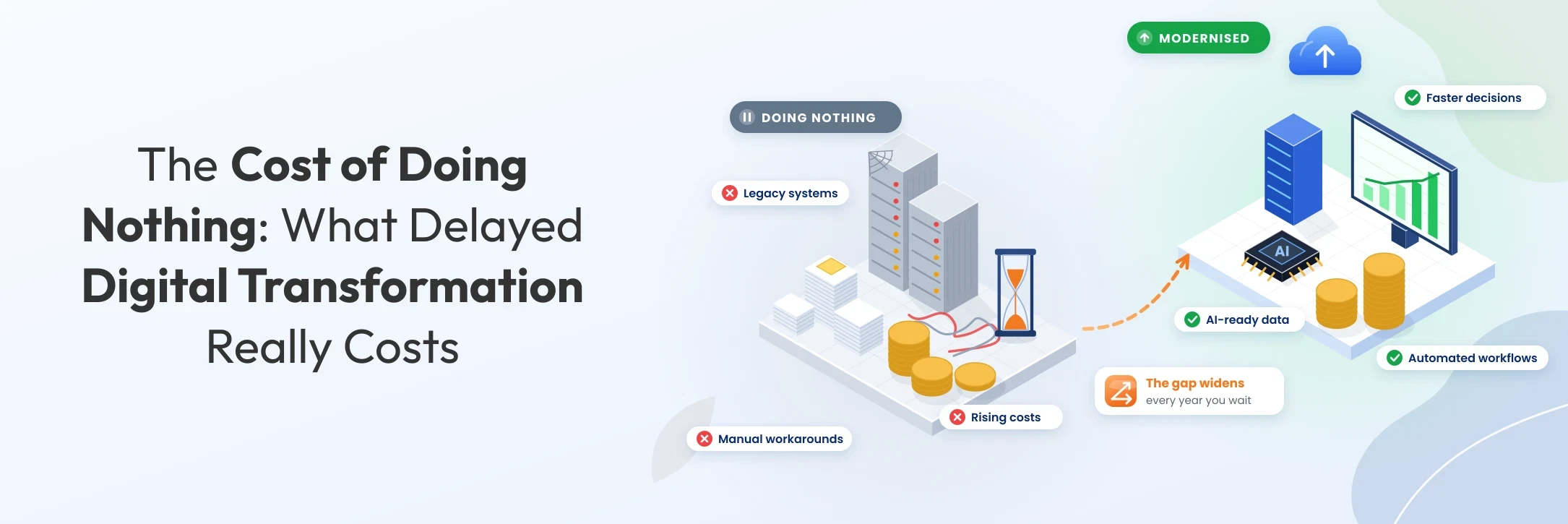
Delaying digital transformation costs businesses far more than the price of new technology. The real cost shows up as lost productivity, manual workarounds, rising operating costs, slower decisions and missed opportunities, and it grows every year the decision is put off.
Most organisations already know digital transformation matters. They delay it anyway, because existing systems still work, teams have adapted, and replacing business-critical technology feels like unnecessary disruption. But transformation isn't about chasing the latest technology. It's about making sure your business can operate efficiently, adapt to change and scale without being held back by outdated systems.
Key takeaways
- The biggest costs of delay are hidden in daily operations, not the IT budget.
- Those costs compound: the longer you wait, the bigger and more expensive modernisation becomes.
- Outdated systems limit growth, competitiveness and AI readiness.
- The smartest approach is phased: fix the biggest bottlenecks first, then build from there.
Why Do Businesses Delay Digital Transformation?
Very few organisations delay transformation because they don't see its value. They delay it because change feels riskier than the status quo. Leadership teams typically worry about:
- Implementation costs and whether the return will justify them
- Disruption to day-to-day operations
- Getting employees to adopt new systems
- Taking focus away from revenue and growth priorities
Over time, businesses also become comfortable with workarounds. Staff learn which spreadsheets fill the gaps, which reports need manual updates and which processes compensate for disconnected applications. Operations keep moving, so it looks as though technology is supporting the business, when in reality people are compensating for its limitations.
The problem is that businesses evolve while their technology often doesn't. New customers, products, regulations and team members all add pressure to systems designed for a much smaller organisation, until manageable inefficiencies become genuine barriers to growth.
What Is the Hidden Cost of Doing Nothing?
The biggest cost of delay rarely appears in the IT budget. It's spread across everyday activities, which makes it hard to measure but impossible to ignore.
A manual approval, a duplicate data entry or a delayed report might only add a few minutes to a task. Across hundreds of employees and thousands of transactions, those minutes become a significant operational expense. Businesses end up paying through lost productivity instead of technology investment.
| Hidden cost | Business impact |
|---|---|
| Manual processes | Lower productivity and more administrative effort |
| Disconnected systems | Slower decisions and inconsistent data |
| Duplicate data entry | More errors and unnecessary rework |
| Legacy software | Higher maintenance costs and less flexibility |
| Limited automation | Operating costs that rise as the business grows |
| Delayed reporting | Slower responses to customers and market changes |
Beyond these lies the biggest cost of all: opportunity cost. Every hour spent managing inefficient processes is an hour not spent improving customer experience, developing products or innovating. It never appears on a financial statement, yet it often has the greatest impact on long-term competitiveness.
How Delayed Digital Transformation Limits Growth
As a business grows, so does its complexity. More customers, transactions, employees and data all increase the demand on existing systems. When technology evolves alongside the business, growth feels manageable. When it doesn't, every milestone gets harder.
Many organisations respond by hiring more people rather than improving the processes those people follow. Teams end up:
- Updating spreadsheets and re-keying data between systems
- Chasing approvals by email
- Preparing reports manually
These workarounds keep things running, but they add cost without adding efficiency. Growth continues, while productivity falls behind. This is usually when leaders realise the issue isn't a shortage of people but a shortage of systems that can support the next stage of growth.
The Cost Doesn't Stay the Same. It Compounds.
A common misconception is that delaying transformation saves money. Usually, the opposite is true. Every year it's postponed, the business accumulates:
- More manual processes and disconnected applications
- More temporary fixes that quietly become permanent
- More fragmented data that's harder to clean and connect
- More complexity to untangle when integrating new technology
What could have been a phased, manageable improvement grows into a far larger and more expensive transformation project. The longer you wait, the more effort it takes, because you're no longer just upgrading technology. You're unpicking years of operational complexity embedded in everyday work.
The Competitive Cost of Standing Still
Digital transformation isn't only about internal efficiency. It also decides how quickly a business can respond to change. Customers expect faster service, employees expect better tools and markets move quicker than ever.
Businesses on outdated systems often struggle to launch new products, adapt to customer expectations or make timely decisions, because the information they need isn't available when they need it. Meanwhile, competitors who modernise gain advantages well beyond cost savings:
- They respond to customers and markets faster
- They automate repetitive work
- They make better use of their data
- They deliver better customer experiences
Over time, that gap widens. This is why digital transformation should be treated as a business strategy, not an IT initiative. It's about agility, resilience and long-term competitiveness, not simply replacing software.
Why Does AI Readiness Depend on Digital Transformation?
Many businesses exploring AI discover that AI isn't their biggest challenge. Their existing systems are.
AI relies on accurate, connected and accessible data. If information is scattered across separate applications, spreadsheets and databases, AI can't produce reliable results. Rather than improving operations, it simply amplifies existing inefficiencies.
That's why businesses increasingly see transformation as the foundation for AI. To get real value from AI, automation and analytics, organisations first need to:
- Modernise legacy systems
- Integrate business applications
- Improve data quality and accessibility
Technology will keep evolving, but the principle stays the same: businesses with strong digital foundations today are best placed to adopt whatever comes next.
6 Signs Your Business Has Waited Too Long
The question isn't whether you have the latest technology. It's whether your current technology is moving the business forward or forcing people to work around it. If several of these sound familiar, the cost of doing nothing is probably already affecting you:
- 01Manual work is part of everyday operations. Staff spend hours updating spreadsheets, preparing reports or moving data between systems.
- 02Your systems don't talk to each other. Teams switch between several applications to complete a single process.
- 03Reporting takes too long. Decisions depend on manually compiled reports rather than real-time insight.
- 04Growth means hiring, not efficiency. Costs rise because processes don't scale with the business.
- 05Change is slow and painful. Launching products, adding tools or adapting to customers takes far longer than it should.
- 06Everyone knows the workarounds. Unofficial processes have become the real way work gets done.
None of these appears overnight, and that's what makes them dangerous. Businesses adapt gradually until inefficiency feels normal.
What Do Smart Businesses Do Next?
Organisations that modernise successfully don't start by replacing every system they own. They start by finding where the biggest inefficiencies are and prioritising the improvements that deliver measurable value. Often, the answer isn't replacement at all, but:
- Integrating existing systems so data flows between them
- Automating repetitive, manual processes
- Modernising legacy applications rather than rebuilding from scratch
- Building targeted solutions that remove specific bottlenecks
A phased approach reduces risk, protects business continuity and delivers value far sooner than a large-scale replacement project.
That's how BSP Technologies® works with clients. Every engagement starts with understanding the business, not recommending technology. By analysing existing workflows, identifying operational friction and aligning technology decisions with business goals, we help organisations modernise in a way that's practical, scalable and built for long-term growth. Digital transformation isn't a one-off project; it's an ongoing process of keeping technology aligned with a business as it evolves.
Final Thoughts
The cost of delayed digital transformation isn't measured by the software you haven't bought. It's measured by the opportunities you've missed, the productivity you've lost and the complexity you've accepted over time.
Doing nothing can feel like the safer choice today, but every month spent on inefficient processes, disconnected systems and outdated technology makes modernisation harder tomorrow. Businesses that act early gain more than efficiency. They become more agile, decide faster, serve customers better and build a stronger foundation for automation, AI and new business models.
The question isn't whether your business will need digital transformation. It's how much waiting is already costing you.
At BSP Technologies®, we help organisations modernise legacy systems, integrate disconnected applications, automate business processes and build scalable software that solves real operational challenges. We don't recommend technology for its own sake; we focus on measurable business outcomes.
Ready to Assess the Cost of Doing Nothing?
If your business spends more time managing processes than improving them, talk to us. We'll assess your current technology landscape and build a roadmap for sustainable growth.
Talk to BSP Technologies®Frequently Asked Questions
It's the combined impact of lost productivity, manual effort, higher operating and maintenance costs, slower decision-making and missed opportunities that builds up while a business relies on outdated systems. It usually far exceeds the cost of the technology itself.
Look beyond software spend. Estimate time lost to manual tasks and re-keying, the cost of errors and rework, rising maintenance on legacy systems, delays caused by slow reporting, and the value of opportunities you couldn't pursue. Together, these give a realistic picture of what delay is costing.
Yes. Most successful initiatives are delivered in phases. Businesses typically tackle their biggest operational challenges first, modernise critical systems, then expand over time, which keeps disruption and costs under control.
Regularly, and especially during periods of growth, expansion or operational change. Regular reviews show whether existing systems still support business goals or whether modernisation should become a strategic priority.