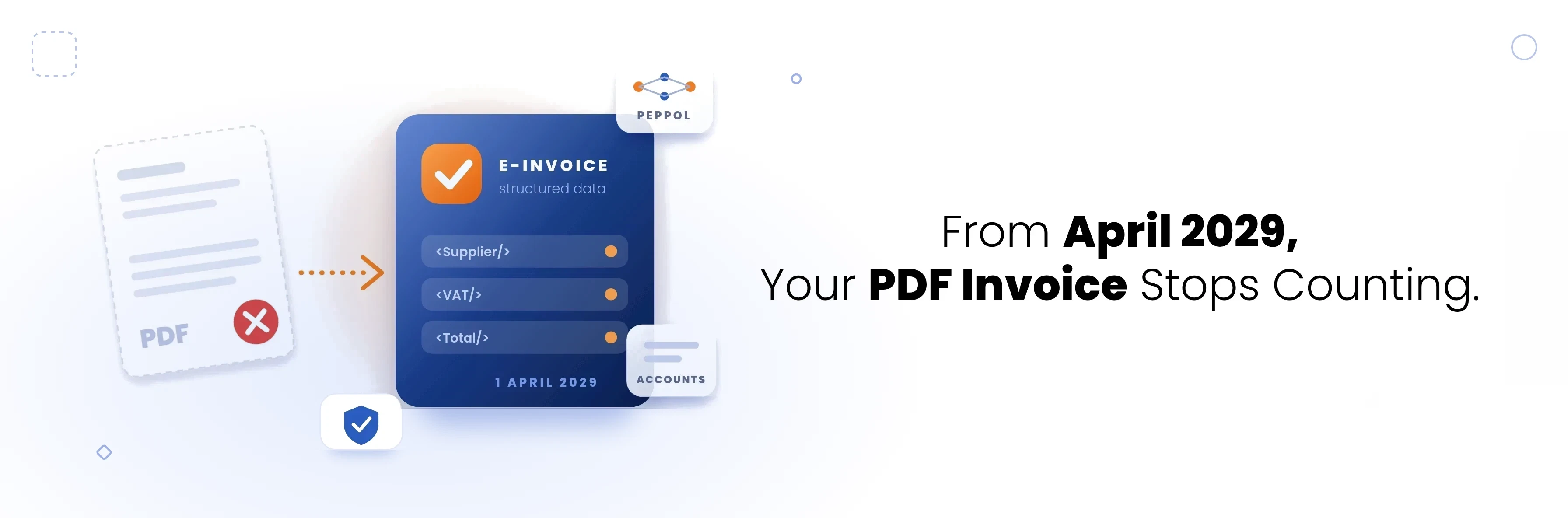
Short answer: From 1 April 2029, VAT-registered UK businesses must send and receive VAT invoices as structured e-invoices over the Peppol network. PDFs won't count. If your invoices are raised inside QuickBooks or Xero, your software provider will do most of the work. If they start in your own platform, CRM or ERP, the integration between those systems is what needs fixing.
That second group is bigger than most people think. And it's the group nobody's writing for.
What is the UK e-invoicing mandate?
E-invoicing means sending an invoice as structured data that the buyer's system can read automatically, rather than as a document a person has to open and type in. The UK government has confirmed that, from 1 April 2029, VAT-registered persons must issue and receive VAT invoices as e-invoices, unless a specific exemption applies.
It covers business-to-business and business-to-government invoices. Sales to consumers are out of scope, and businesses that aren't VAT registered aren't mandated. A narrow exemption for the digitally excluded will follow the existing Making Tax Digital model.
What did HMRC's October 2026 roadmap confirm?
On 28 October 2026, HMRC and the Department for Business & Trade published the Roadmap for e-invoicing implementation. The most important line for anyone running software: "Peppol will be the UK's core interoperability framework."
Peppol is an international network for exchanging e-invoices. Businesses connect through certified Access Points, usually provided by their software supplier. You won't need to become an Access Point yourself. KPMG's analysis describes it as a four-corner model and notes that invoices won't be sent to HMRC simply because they travel over Peppol.
Key dates between now and April 2029
| When | What happens |
|---|---|
| Spring 2027 | Public technical consultation on UK e-invoicing standards |
| Autumn 2027 | Further guidance on EDI and legacy systems |
| October 2027 - April 2028 | Detailed requirements published: scope, standards, business identifiers, software requirements |
| Summer 2028 | Readiness testing |
| 1 April 2029 | Mandate goes live |
The roadmap also says the government doesn't plan to change the requirements after April 2028. In practice, that leaves about a year between final rules and go-live.
Why won't PDF invoices count any more?
Because a PDF is a picture of an invoice, not data. The government's roadmap is explicit: invoices shared as digital files but not as structured data are not classed as e-invoices. Its examples include PDFs, Word documents, JPEGs, HTML and fax.
That matters if your current process is "the platform generates a PDF, someone emails it, and finance types it into Xero". Every step of that chain changes.
Who is most exposed?
If your invoices start in QuickBooks or Xero
You're in the best position. The roadmap expects limited changes to familiar processes for many businesses already using accounting software. Several providers already offer e-invoicing, and some have committed to include it at no extra cost once it's required. Ask your provider for their plan and timeline, and check your customer records are clean.
If your invoices start in your own platform, CRM or ERP
This is where the risk sits. Think of a wholesaler whose orders and invoices come out of a bespoke trade portal, a services firm billing from a CRM, or a manufacturer invoicing from an in-house system. The invoice is created in one place and only reaches QuickBooks or Xero later, by sync, by CSV import, or by someone re-keying it.
From 2029, the invoice has to be correct, structured data at the point it's issued. That means:
- the source system must hold clean customer identifiers and VAT details
- tax codes and product codes must match what your accounting software expects
- the sync must handle errors and conflicts instead of silently failing
- someone must be able to see an audit trail when things don't match
Off-the-shelf plug-ins rarely cover a custom platform properly. This is integration work.
How do you get your systems e-invoicing ready?
Five steps, in this order:
- 01Map where every invoice is created. Platform, CRM, ERP, e-commerce site, and the spreadsheet nobody admits to.
- 02Trace the path to your accounts. API sync, file import, manual re-keying or an emailed PDF? Write it down for each source.
- 03Clean your customer and supplier data. Duplicate records, missing VAT numbers and inconsistent tax codes will all surface once invoices become structured data.
- 04Ask your software providers about their plans. Your accounting software and every connected platform should be able to tell you how they'll support Peppol, and when.
- 05Replace manual steps with a reliable sync. Retire re-keying and PDF hand-offs in favour of a two-way integration with error handling and an audit trail, before summer 2028 testing.
If step 1 reveals invoices coming out of an old in-house system that nobody wants to touch, phased modernisation may need to come first. Not sure whether your system is worth fixing? Our £100 System Health Check gives you a one-page verdict.
Why fix the sync now, not in 2028?
Because a broken sync is costing you today. Every hour spent matching your platform to your accounts, every invoice mismatch at month-end, every customer disputing a bill, that's money now, not in 2029.
We've seen what a properly built integration is worth. On one QuickBooks integration, we closed a £35K gap and the client retained a £120K contract. That wasn't a compliance project. It was a business problem that clean, synced data solved.
E-invoicing simply sets a hard deadline on a job that already pays for itself.
How BSP approaches QuickBooks and Xero integration
We build real-time, two-way sync between QuickBooks or Xero and whatever platform your business actually runs on, with error handling, conflict resolution and an audit trail. Not a plug-in that works until it doesn't. A few things worth knowing about how we work:
- 01Founder-level review. Nirav personally reviews every project at kickoff, so scope and architecture decisions aren't left to a junior project manager.
- 02Long relationships. We've been building since 2013. Our 10-year partnership with Tyre Channel UK took a paper-based business fully digital, with £10M+ in business impact and no delivery miss.
- 03Continuity. 95% team retention (industry average: 30-40%) and an 80% repeat client rate. The engineers who build your sync are the ones who maintain it when the rules are finalised.
We'll tell you what you need to hear: if your setup will be fine with a provider update, we'll say so.
Want to know how exposed your invoicing is? Book a 30-minute call with Nirav and see how our QuickBooks and Xero integration work could fit.
Book a 30-minute call with Nirav
Find out how exposed your invoicing is before the rules are final.
Book a 30-minute call with NiravFrequently Asked Questions
From 1 April 2029, VAT-registered businesses must issue and receive VAT invoices as e-invoices, unless an exemption applies. This was confirmed in the HMRC and Department for Business and Trade roadmap published on 28 October 2026.
Not as e-invoices. The government roadmap says invoices shared as digital files but not as structured data, such as PDFs, Word documents or images, are not classed as e-invoices.
If every invoice is raised inside your accounting software, the government expects limited changes, usually handled by your software provider. If invoices are raised in another system and copied or synced across, that integration needs checking.
Peppol is the international network the UK has chosen for exchanging e-invoices. Businesses connect through certified Access Points, usually via their software provider, and will not need to become Access Points themselves.
The roadmap says detailed requirements, including standards and business identifiers, will be published between October 2027 and April 2028, with a public technical consultation in spring 2027 and readiness testing in summer 2028.
Sources
1. HM Revenue & Customs and Department for Business & Trade, Roadmap for e-invoicing implementation, GOV.UK, published 28 October 2026: GOV.UK roadmap
2. HM Revenue & Customs, E-invoicing requirements, GOV.UK: GOV.UK e-invoicing requirements
3. KPMG, UK: HMRC publishes B2B e-invoicing implementation roadmap from April 2029, TaxNewsFlash, 28 October 2026: KPMG analysis